
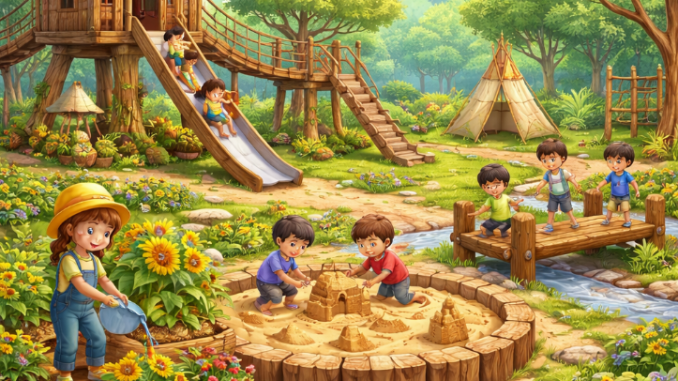
Play is the work of childhood. This simple yet profound statement by child development pioneer Jean Piaget encapsulates the critical role of play in a child’s life. It is through play that children learn to navigate the world, develop essential skills, and grow into well-rounded individuals. While traditional classrooms and structured activities have their place, there is a growing movement to reconnect children with the natural world through nature-inspired play areas. These spaces, which incorporate elements like wood, stone, sand, and water, offer a rich sensory experience that can enhance a child’s physical, cognitive, and emotional development. [1]
However, the idea of letting children play in a more natural, less structured environment can raise concerns about safety. How can we create a space that is both stimulating and secure? This article will explore the benefits of nature play, provide practical tips for designing safe and engaging natural play areas, and offer ideas for bringing the beauty of the outdoors to your own backyard or schoolyard.
The Power of Nature Play
The benefits of spending time in nature are well-documented, and this is especially true for children. Research has shown that nature play can have a positive impact on everything from physical health to mental well-being. [2]
One of the most obvious benefits of outdoor play is the opportunity for physical activity. Running, jumping, climbing, and balancing on uneven surfaces all help to develop a child’s gross motor skills, coordination, and strength. In an age where childhood obesity is a growing concern, providing opportunities for active play is more important than ever.
Beyond the physical benefits, nature play can also have a profound impact on a child’s mental and emotional health. Studies have shown that spending time in nature can reduce stress, improve focus, and increase feelings of happiness and well-being. [3] The unstructured nature of this type of play also encourages creativity and problem-solving, as children are free to invent their own games and scenarios.
Designing for Safety in Natural Playgrounds
While the benefits of nature play are clear, it is essential to create a safe environment for children to explore. A well-designed natural playground should be a space where children can challenge themselves and take appropriate risks, but it should also be free from any major hazards.
When designing a natural play area, it is important to consider the age and developmental stage of the children who will be using it. Younger children will need a more protected environment with smaller-scale features, while older children will be ready for more challenging activities. The National Safety Council provides comprehensive guidelines for playground safety, which can be a valuable resource for parents and educators. [4]
One of the most important aspects of playground safety is ensuring that the play area is free from any potential hazards. This includes things like sharp objects, toxic plants, and unstable structures. It is also important to have a soft surface under any climbing equipment to cushion falls. While natural materials like wood chips and sand are a good option, it is important to ensure that they are installed at the correct depth.
Trees are a wonderful addition to any play area, providing shade, a place to climb, and a connection to the natural world. However, it is crucial to ensure that any trees in the play area are healthy and well-maintained. Dead or dying branches can pose a serious safety risk. For this reason, it is always a good idea to consult with certified arborists in Cedar Park to assess the health of your trees and perform any necessary pruning or removal.
Bringing Nature to Your Backyard or Schoolyard
You don’t need a large, wooded area to create a nature-inspired play space. With a little creativity, you can bring the beauty and benefits of nature to even the smallest of backyards or schoolyards. The key is to incorporate a variety of natural elements that will engage a child’s senses and spark their imagination.
One of the easiest ways to get started is to create a sensory garden. This can be as simple as a few pots of herbs and flowers, or it can be a more elaborate space with a variety of plants, textures, and scents. A sensory garden provides a wonderful opportunity for children to learn about the natural world through their senses. They can touch the soft leaves of a lamb’s ear plant, smell the fragrant blossoms of a lavender plant, and taste the sweet fruit of a strawberry plant.
Another great way to bring nature to your play area is to incorporate natural building materials. For smaller spaces, wall toys can be a great way to provide engaging activities without taking up valuable floor space. A pile of logs or branches can be transformed into a fort, a den, or a secret hideout. A sandbox can provide hours of entertainment, as children can dig, pour, and build to their heart’s content. You can also create a ‘mud kitchen’ where children can mix mud, water, and leaves to create their own concoctions. While it may be messy, this type of sensory play is incredibly valuable for a child’s development.
For those looking for more structured play equipment, there are many companies that specialize in natural playgrounds. These companies use materials like wood, rope, and stone to create beautiful and engaging play structures that blend in with the natural environment. From climbing walls to rope bridges, these playgrounds offer a wide range of challenges for children of all ages. One of the many engaging products you can find on SensoryEdge is the Exploring and Using a Classroom Seating Rug, which can be a great addition to an indoor play area.
The Importance of Risky Play
In our increasingly risk-averse society, it can be tempting to create a play environment that is completely free from any potential dangers. However, child development experts argue that ‘risky play’ is actually essential for a child’s development. Risky play is any type of play that involves a sense of thrill or a fear of getting hurt. This can include things like climbing high, swinging fast, or playing with ‘dangerous’ tools.
While it may seem counterintuitive, allowing children to engage in risky play can actually make them safer in the long run. By learning to assess and manage risks in a controlled environment, children develop a better sense of their own abilities and limitations. They also learn to be more resilient and to bounce back from failure. Of course, it is important to strike a balance between allowing for risky play and ensuring a child’s safety. The key is to create a space where children can challenge themselves without being exposed to any serious hazards.
Fostering a Love of Nature
Creating a nature-inspired play area is only the first step. To truly foster a love of nature in children, it is important to encourage them to engage with the natural world on a regular basis. This can be as simple as going for a walk in the park, or it can be a more involved activity like planting a garden or going on a camping trip.
It is also important to model a love of nature for your children. If they see you enjoying the outdoors, they are more likely to develop a positive attitude towards nature themselves. Talk to them about the plants and animals you see, and encourage them to ask questions. By sharing your own sense of wonder and curiosity, you can help to instill a lifelong love of nature in your children.
Conclusion
In a world that is becoming increasingly disconnected from the natural world, it is more important than ever to provide children with opportunities to play and learn in nature. By creating safe and engaging nature-inspired play areas, we can help to foster a generation of children who are not only healthier and happier, but who also have a deep and abiding respect for the environment. Whether you have a large backyard or a small schoolyard, there are countless ways to bring the beauty and benefits of nature to the children in your life. With a little creativity and a commitment to safety, you can create a space where children can grow, learn, and thrive.
References
[1] Children & Nature Network. (n.d.). Research and Reports. Retrieved from https://www.childrenandnature.org/research-reports/
[2] National Association for the Education of Young Children (NAEYC). (2019, May). Why Outdoor Play Is Essential for Healthy Development. Retrieved from https://www.naeyc.org/resources/pubs/yc/may2019/outdoor-play-is-essential
[3] Madison College. (n.d.). Playing in nature: Simple, fun and important for your child’s growth. Retrieved from https://mcm.org/playing-in-nature-simple-fun-and-important-for-your-childs-growth/
[4] National Safety Council. (n.d.). Playground Safety. Retrieved from https://www.nsc.org/community-safety/safety-topics/child-safety/playground-safety
