
Why Multi-Planar Input Matters – and Why the Dizzy Disc Delivers It
Most spinning toys operate in a single plane. The Dizzy Disc doesn’t. Here’s a precise look at what that distinction means clinically, and why it matters for the children in your practice.
When an occupational therapist selects a piece of equipment for a clinic, the question isn’t whether children will enjoy it. The question is whether it earns its floor space by doing clinical work efficiently across a range of clients and goals. The Dizzy Disc earns that floor space. This post explains precisely why.
The vestibular system doesn’t process movement in a single dimension. It integrates input across all three planes simultaneously – detecting linear acceleration, angular velocity, gravitational pull, and the body’s orientation in space through the utricle, saccule, and three semicircular canals of the inner ear. Most therapeutic movement tools, however, challenge only one plane at a time. A standard swing moves in the sagittal plane. A lateral rocker addresses the frontal plane. Basic spin discs deliver rotational input in the transverse plane only.
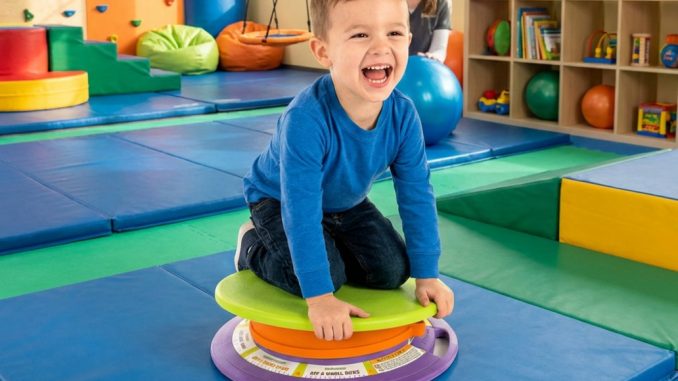
The Dizzy Disc is different. Its combination of free rotation and an adjustable base angle means that a child is rarely working in a single plane at all. What looks like a simple spinning toy is, mechanically, a multi-planar vestibular challenge – and that distinction has meaningful implications for how you use it in practice.
The Three Planes, and What the Dizzy Disc Does in Each
This layered input is what differentiates the Dizzy Disc from a basic spin disc. It isn’t more of the same – it’s a different category of input. For children who have plateaued on single-plane vestibular activities, or for whom the therapeutic goal involves integrating movement across systems, this matters.
The Adjustable Angle: Precision Grading in a Single Tool
The base of the Dizzy Disc can be set to multiple slope positions, from flat to a pronounced incline. This is more than a difficulty dial, it’s a mechanism for targeting specific therapeutic outcomes with the same piece of equipment.
The practical value for a busy clinic: you can use a single piece of equipment across a broad range of clients and stages of treatment. A child beginning sensory integration work starts flat. As processing improves and goals advance, you increase the angle. One tool, a genuine progression not just the same exercise done harder.
Body Position: The Third Variable
Plane of motion and angle of tilt are two of the three variables the Dizzy Disc offers. The third is body position and it’s the one most clinicians find immediately useful for targeting specific muscle systems and functional goals.
| Position | Primary Muscle Recruitment | Clinical Application |
|---|---|---|
| Seated, criss-cross | Deep lumbar stabilizers, hip flexors, lateral trunk musculature | Core stability, floor-sitting endurance, foundational postural control |
| Seated, legs extended | Hamstrings, lumbar extensors, posterior chain engagement | Posterior chain integration, hamstring length with dynamic load |
| Kneeling | Gluteals, hip stabilizers, bilateral ankle and knee co-contraction | Transitional movement goals, lower extremity co-contraction, pelvic stability |
| Prone (lying face down) | Spinal extensors, scapular stabilizers, neck extensors | Extensor tone, prone tolerance, proprioceptive processing through upper extremities |
| Supine (lying face up) | Abdominals, neck flexors, hip flexors | Flexor pattern work, vestibular processing in a novel orientation |
This variability means the Dizzy Disc doesn’t lock you into a single intervention profile. The same piece of equipment that you use for core stability work with one child can be repositioned for extensor tone work with the next. That flexibility is especially valuable in a practice where session time is compressed and equipment changes are disruptive.
Because body position, tilt angle, and spin speed are all independently variable, the Dizzy Disc allows for genuine grading across multiple parameters simultaneously. This is not a common feature in sensory equipment at this price point. Most tools offer one axis of progression. The Dizzy Disc offers three.
Who Benefits, and When to Introduce It
The multi-planar nature of the Dizzy Disc makes it relevant across a wider diagnostic range than most vestibular tools. Children with sensory processing disorder who seek vestibular input respond immediately and strongly – the disc gives them what they’re looking for in a contained, safe format. But it’s not limited to sensory seekers.
Children with low postural tone benefit from the constant demand for active stabilization during rotation. Children on the autism spectrum who engage in self-directed spinning often transition naturally to the Dizzy Disc, allowing the therapist to introduce structure and progression into what was previously unguided sensory behavior. Children with developmental coordination disorder benefit from the proprioceptive feedback the textured surface provides, combined with the balance challenge of maintaining position through rotation.
For introduction, begin flat and seated. Observe postural response during slow rotation before increasing speed or introducing tilt. Children who show significant gravitational insecurity should be introduced to the disc with manual support and at minimal speed. The 150 lb weight capacity keeps it relevant through adolescence, which is unusual for equipment in this category and extends its utility for clinics serving older children and teens.
Practical Considerations for Clinic Use
The Dizzy Disc is built for repeated, heavy use. The textured surface provides proprioceptive input through the hands, knees, or feet depending on position, and holds up to daily clinic wear without degradation. The integrated carry handle matters more than it might seem – it means the disc moves between therapy spaces, outdoor areas, or home programs without requiring a storage solution. No box. No assembly. Pick it up and go.
For home programs, the disc translates well. Its design is intuitive enough that parents can implement therapist-directed activities without supervision, which increases the frequency of therapeutic input outside clinic hours. Recommending it as a home program tool alongside clinic use is a practical way to extend treatment goals between sessions.
It is worth noting that the Dizzy Disc is not appropriate for every client. Children with acute vestibular disorders, unmanaged seizure conditions, or significant motor control limitations that prevent safe self-regulation of spin speed should be evaluated carefully before use. As with any vestibular tool, clinical judgment governs introduction and progression.
The Dizzy Disc at SensoryEdge
Built for clinical use. 150 lb capacity, adjustable angle, integrated carry handle. Free shipping. Ready to use out of the box.
View the Dizzy Disc →