
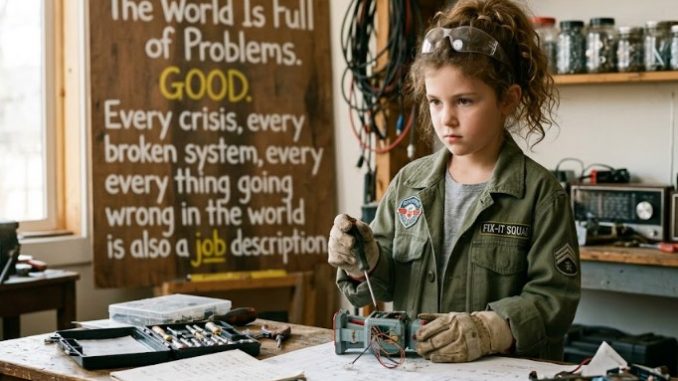
The World Is Full
of Problems.
Good.
Every crisis, every broken system, every thing going wrong in the world is also a job description. These are the people who get paid to show up when everything is falling apart.
Children paying attention to the world right now are not being dramatic. The problems are real. What they are rarely told is that there are entire professions built around solving them.
Every disaster has a team that prepared for it. Every outbreak has scientists who modeled it before it started. Every piece of misinformation spreading online has researchers who study how it moves and how to stop it. Every conflict has negotiators who spend their careers learning to de-escalate what politicians and armies cannot resolve. The world is not simply broken and unfixable. It is broken in specific ways that specific people have made it their life’s work to address.
That is a different story than the one most anxious, news-aware children are carrying. And it is important to tell it, not to minimize the problems, but because the children who feel most urgently about the state of things are often exactly the ones those fields need.
“Anxiety about the world is not a problem to be managed. In the right hands, it is a career. The question is what kind of problem the child most wants to spend their life trying to solve.”
What follows is a field guide to ten careers built around some of the most pressing problems of our time. None of them are glamorous in the Hollywood sense. All of them are consequential in the real one.
For kids who think about worst-case scenarios and want to do something about them.
Disasters are increasingly predictable, but governments and organizations consistently underprepare because the risks are not made visible until it is too late.
They build probabilistic models of how disasters unfold: earthquakes, floods, wildfires, industrial failures, cascading infrastructure collapses. Their job is to make invisible risk visible before an event, not after. They work with governments, insurance companies, humanitarian organizations, and militaries to ensure that when something goes wrong, the response was already planned and resourced. The best in the field have saved hundreds of thousands of lives through buildings that were never built in flood plains, evacuation routes that existed before the fire started, and supply chains that were pre-positioned before the storm made landfall.
Statistical modeling, systems thinking, geographic information science, scenario planning, and the ability to communicate probabilistic risk to decision-makers who want certainty.
UN agencies, national emergency management systems, the World Bank, insurance and reinsurance firms, climate adaptation programs, and large infrastructure projects.
The Sendai Framework, the global blueprint for disaster risk reduction, was built on decades of analyst research showing that every dollar invested in disaster preparedness saves between four and eleven dollars in disaster response costs. The profession is not optimistic. It is cost-effective.
Infectious diseases with pandemic potential emerge regularly. The window between first detection and global spread is shrinking as populations, travel, and land-use patterns change.
They design the systems that allow governments and health organizations to detect, contain, and respond to outbreaks before they become pandemics. This includes surveillance networks, stockpile strategies, rapid diagnostic infrastructure, international coordination protocols, and communication plans for reaching populations during a crisis. They do most of their work during the quiet periods, which is precisely when nobody is listening, and when their work matters most.
Epidemiology, public health policy, logistics and supply chain management, cross-border coordination, and the ability to plan for scenarios that have not happened yet but will.
The WHO, CDC, national public health agencies, the Gates Foundation, academic research centers, and governments that take the question of future pandemics seriously.
A 2019 Johns Hopkins Global Health Security Index assessment rated most countries poorly on pandemic preparedness, exactly one year before COVID-19. The researchers who built that index had been warning for a decade. The profession exists specifically because those warnings had not been acted on.
For kids who notice when something doesn’t add up and can’t let it go.
False information spreads faster than corrections, causes measurable public health harm, undermines elections, and fuels violence. No existing institution was built to address it at scale.
They study how misinformation is created, how it spreads through networks, why people believe it, and what interventions actually work to slow it. They use social network analysis, cognitive psychology, computational linguistics, and political science together. Their findings inform platform policy, media literacy curricula, public health communication, and government responses to influence operations. The field barely existed fifteen years ago. It is now one of the most in-demand research areas in the world.
Data analysis, network science, psychology of belief and persuasion, platform literacy, and the intellectual discipline to study falsehoods without becoming cynical about truth itself.
University research centers, think tanks, tech platforms, journalism organizations, government digital agencies, and international organizations monitoring election integrity.
Research from MIT’s Media Lab found that false news spreads six times faster on social media than true news, and is seventy percent more likely to be retweeted. That single finding changed how every major platform thinks about its recommendation algorithms.
Powerful institutions routinely conceal wrongdoing. Much of what shapes public life, from financial fraud to war crimes, happens in the dark and stays there unless someone is specifically trained to bring it into the light.
They investigate wrongdoing using the tools of journalism combined with forensic methods: satellite imagery analysis, leaked document verification, financial record examination, open-source intelligence, and witness testimony corroboration. They are not reporters in the traditional sense. They are investigators who publish. Their work has toppled governments, exposed atrocities, recovered stolen assets, and freed wrongfully imprisoned people.
Document analysis, OSINT tools, financial forensics, source protection, legal literacy around evidence standards, and the ability to tell a complex story clearly to a public audience.
Outlets like ProPublica, the Intercept, and Bellingcat, international collaborative networks like ICIJ, in-house investigative teams at major newspapers, and independent organizations funded by journalism foundations.
Bellingcat, a forensic journalism organization founded in 2014, used commercially available satellite imagery and open-source analysis to identify the Russian military unit responsible for shooting down Malaysia Airlines Flight MH17, producing findings that matched classified intelligence assessments without access to any classified material.
For kids who are troubled by why people fight and instinctively look for another way.
Most conflicts, from neighborhood disputes to international crises, escalate past the point of resolution not because they are irresolvable, but because no one with the right skills entered the room early enough.
They facilitate negotiated resolutions between parties in conflict: labor disputes, community tensions, business disagreements, inter-ethnic violence, and international crises. Professional mediators are trained in a specific set of skills that most people are never taught: how to help people in conflict hear each other, how to separate positions from underlying interests, how to build agreements that both sides will actually honor. The work operates at every scale, from a family dispute to a peace process between nations.
Active listening at a professional level, negotiation theory, psychology of conflict and de-escalation, cultural competency, and the patience to work at the pace of trust, not the pace of urgency.
Community mediation centers, law firms, HR departments, international NGOs, the UN, government conflict resolution agencies, and as independent consultants in high-stakes commercial and political disputes.
The Oslo Accords, the 1993 peace framework between Israel and the PLO, were initiated not by governments but by a small team of academic mediators from Norway’s FAFO research foundation who spent years building the back-channel trust that formal diplomacy could not. Professional mediators created the conditions that statesmen walked into.
Wars end. What comes after is often the harder problem: how do you rebuild institutions, economies, and social trust in places where all three have been systematically destroyed?
They work in the aftermath of conflict to rebuild the functioning systems a society needs: judicial processes, public administration, economic infrastructure, healthcare systems, and educational institutions. It is not aid work in the humanitarian sense. It is applied political science, economics, and public administration in the most difficult conditions imaginable. The field draws on lessons from every post-conflict reconstruction effort since World War Two, learning what works and what has repeatedly failed.
Political science, development economics, public administration, security sector reform knowledge, and the cultural fluency to work effectively inside societies vastly different from your own.
The UN, World Bank, USAID, bilateral development agencies, international NGOs, and academic research centers that study what makes post-conflict transitions succeed or collapse.
Rwanda’s post-genocide reconstruction, which transformed one of the world’s most traumatized societies into one of Africa’s fastest-growing economies within a generation, drew directly on post-conflict specialists from international organizations who helped design judicial, economic, and educational frameworks from the ground up.
For kids who notice how things connect, and what happens when those connections break.
The physical systems that modern life depends on, power grids, water networks, transport, digital infrastructure, were mostly designed for a world that no longer exists. They are aging, increasingly interdependent, and increasingly fragile.
They design and assess infrastructure specifically for its ability to absorb disruption and keep functioning: power grids that can survive cyberattacks or extreme weather, water systems that continue to operate when one component fails, transport networks with enough redundancy that a single bridge collapse does not paralyze a region. They think about failure modes the way a chess player thinks about their opponent’s best moves: systematically and in advance.
Civil or systems engineering, failure mode analysis, network theory, climate risk assessment, and the ability to design for scenarios that have not happened but eventually will.
National infrastructure agencies, engineering consultancies, utility companies, government defense and security departments, and international development banks funding infrastructure in climate-vulnerable regions.
The 2003 Northeast blackout, which affected 55 million people across the US and Canada, was traced to a software bug in a single Ohio utility’s alarm system. Infrastructure resilience engineers have since redesigned grid interconnection standards specifically so that a single failure point cannot cascade across an entire region.
Bacteria are evolving resistance to antibiotics faster than new ones are being developed. If the trend continues, routine infections and standard surgeries could become life-threatening within decades.
They work on one of the most consequential slow-moving crises in medicine: the possibility that the antibiotics underpinning modern healthcare stop working. Some study the mechanisms of resistance to find new drug targets. Others work on alternatives like bacteriophage therapy. Others focus on agricultural antibiotic use, which drives resistance in ways that affect human medicine. The problem is biological, economic, regulatory, and behavioral all at once, and requires researchers who can work across all of those dimensions.
Microbiology, molecular biology, pharmacology, epidemiology, and increasingly data science for tracking resistance patterns across global clinical and environmental samples.
University research labs, pharmaceutical companies, the WHO, national health agencies, agricultural policy bodies, and international coalitions like the Global AMR Research and Development Hub.
The WHO lists antimicrobial resistance as one of the top ten global public health threats facing humanity. A 2022 Lancet study attributed 1.27 million deaths directly to antibiotic-resistant infections in a single year, making it already larger in scale than many more visible crises. The researchers working on it are doing so largely out of public view.
For kids who think about why people hurt each other, and whether that can change.
Most institutions, schools, prisons, hospitals, welfare systems, were designed without accounting for trauma. As a result, they often re-traumatize the people they are meant to help.
They redesign institutions and service systems so they function in ways that do not harm traumatized people further. They work with schools to change how they respond to behavioral problems, with criminal justice systems to reduce retraumatization during processing, with healthcare providers to change how histories are taken and procedures are conducted. The work combines clinical psychology, organizational design, policy, and training. It is not therapy. It is systems change informed by trauma science.
Trauma psychology, organizational change management, training design, policy development, and the ability to persuade institutions to change practices that feel normal to them but are harmful to the people they serve.
School districts, child welfare agencies, juvenile justice systems, hospitals, refugee services, and government departments working on social and health equity.
Philadelphia’s adoption of trauma-informed practices across its school district, following a decade of research implementation, produced measurable reductions in disciplinary referrals, suspensions, and student disengagement. The same research framework has since been implemented in school systems across more than forty countries.
The worst thing a classroom can do with a child’s sense of urgency about the world is redirect it toward something less uncomfortable. That urgency is information. It belongs in the lesson.
When a news story enters the classroom, ask: who is the professional trying to fix this? A flood is not just a tragedy. It has disaster risk analysts, emergency managers, hydrologists, and climate adaptation planners attached to it. Make those people visible.
A child who worries about pandemics is demonstrating systems thinking and risk awareness. A child troubled by conflict is demonstrating empathy and moral reasoning. These are not burdens to manage. They are the beginning of vocational direction.
Many children experience world problems as monolithic and hopeless. Breaking a problem into its components, and showing which components have professionals working on them, changes the emotional register from despair to engagement.
Most visible careers respond to problems. The careers in this post largely prevent them. That framing is powerful for students who want to do something meaningful before the crisis, not just during it.
Mediation, evidence evaluation, system mapping, risk assessment: all of these are teachable skills that also happen to be the core competencies of careers in this post. The classroom is a low-stakes place to practice them deliberately.
Ask directly: what is the problem in the world that bothers you most? Then work backward to find the career attached to it. The exercise often produces more genuine career thinking than any formal counseling session.
“A student who cannot stop thinking about a problem is not distracted. They have already found their field. The teacher’s job is to hand them a map of the profession built around it.”
There is a version of the future where the children most troubled by the state of the world grow up, feel overwhelmed, and disengage. That version is common. It produces people who care deeply and do relatively little, not from laziness but from never having been shown that their specific anxiety mapped onto a specific profession that needed them.
There is another version. In it, the child who could not stop thinking about outbreaks becomes the person who designed the surveillance system that caught the next one early. The child who stayed up at night worrying about misinformation becomes the researcher whose work changed how a billion people interact with information online. The child who could not understand why the adults kept going to war becomes the mediator in the room when two parties are three hours from a ceasefire.
The problems in this post are not hypothetical. They are active. The professionals working on them are real. And the children who feel most urgently about the world right now are, in many cases, exactly who those fields are waiting for.
Tell them that.
