
You Don’t
Have to Choose
Every kid is told at some point to pick a side: science or art, business or creativity, words or numbers. The careers nobody talks about are the ones that ignored that instruction entirely.
There is a moment in most children’s education when someone, with good intentions, tells them they are “a math person” or “a creative person.” And just like that, half the world quietly closes.
It’s one of the most limiting ideas we pass down, and it doesn’t hold up. The assumption that disciplines are mutually exclusive, that choosing one means abandoning another, was never accurate. It just felt tidy to organize schools that way.
The real world is messier and more interesting. The most compelling problems, the ones that actually need solving, almost never live cleanly inside a single discipline. They sit in the gaps between them. And the people who can work comfortably in those gaps, who were never fully convinced they had to pick a side, are the ones the future is being built around.
“The best careers of the next generation won’t belong to the specialists or the generalists. They’ll belong to the people who can hold two fluencies at once and make them talk to each other.”
What follows is a collection of careers built exactly that way. Each one is the product of two disciplines that are rarely taught in the same classroom, rarely found in the same textbook, and almost never mentioned in the same sentence. Together, they make something that neither could build alone.
For kids who love both and are told that’s impossible to sustain.
They draw, paint, and animate the human body for textbooks, surgical training, courtrooms, and patient education. A medical illustrator must understand anatomy precisely enough to teach it, and understand art well enough to communicate it. When a surgeon needs to explain a procedure to a patient, or a courtroom needs to visualize an injury, a medical illustrator made the image that does the explaining.
A biologist can describe a surgical procedure with perfect accuracy and lose the room. An artist can draw a beautiful image of the human body that communicates nothing useful. The illustrator translates between those two worlds. The science tells you what is true. The art tells you how to make someone understand it.
Da Vinci’s anatomical drawings, made in the 1490s, were so accurate they were used as surgical reference material for over three centuries. The combination was indispensable before anyone had a name for it.
They translate complex scientific research into stories that non-scientists can understand, trust, and care about. In a world flooded with health misinformation, climate confusion, and misrepresented studies, the science journalist is one of the few people capable of cutting through it. They have to understand the science well enough to know when it’s being distorted, and write well enough to hold a reader’s attention.
A scientist can write a technically accurate paper that no one outside their field reads. A journalist with no scientific training can write a compelling story that misrepresents the research entirely. The science journalist is what happens when both literacies live in the same person.
During the pandemic, the science journalists who had genuine epidemiology backgrounds were the ones who caught and corrected major errors in early reporting. The combination was not cosmetic. It changed what the public understood.
For kids who like both rules and systems, and can’t decide which to study.
They work at the intersection of how AI systems actually function and how governments, companies, and societies should regulate them. They need to understand enough about how AI models are built to know when a proposed regulation would work, and enough about law and ethics to know what outcomes we should actually be trying to prevent. Right now there are not nearly enough of them, and the decisions being made without them are consequential.
A lawyer without technical knowledge writes AI regulations that don’t map to how these systems actually work. An AI engineer without policy training builds systems without thinking about who they harm. The people who can hold both are rare, and the gap is obvious every time you read about a badly designed regulation or a poorly governed AI product.
The EU AI Act, one of the world’s first major AI regulations, required teams of people with both legal training and deep technical fluency to write. It remains one of the most contested documents of its kind because that combination of expertise is genuinely hard to find.
They follow money through financial records to find fraud, corruption, embezzlement, and hidden assets. They work with law enforcement, law firms, and companies on investigations that are part puzzle, part detective story, and entirely dependent on understanding how financial systems can be gamed. No spreadsheet is just a spreadsheet once they’re in the room.
A detective without financial literacy can’t read the evidence. A standard accountant isn’t trained to look for it. The forensic accountant is specifically built for the overlap, reading a balance sheet the way a detective reads a crime scene.
The Enron collapse in 2001, one of the largest corporate frauds in history, was unraveled primarily by forensic accountants who identified how the numbers had been deliberately obscured. The investigation lasted years and required fluency in both financial systems and legal evidence standards.
For kids who play an instrument and still love math. Told often that they must eventually commit to one.
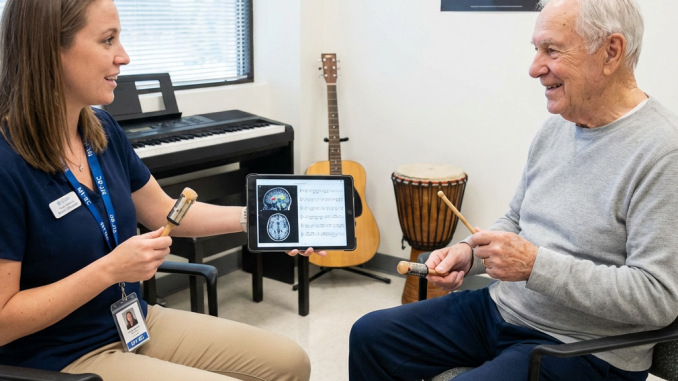
They use music, deliberately and clinically, to support people recovering from strokes, managing dementia, coping with trauma, or developing communication skills. It is not background music and good intentions. It is a structured clinical intervention built on a growing body of neuroscience showing exactly what happens to the brain when it processes rhythm, melody, and pattern. The music is the medicine.
A musician without clinical training can play beautifully and have no framework for treating anything. A psychologist without deep musical knowledge cannot design interventions built around the specific properties of sound that affect the brain. The music therapist is trained in both and uses both simultaneously.
Patients with severe Parkinson’s disease, who struggle to initiate movement, can often walk in rhythm to music with dramatically improved gait. The neuroscience behind this is now well-documented. Music therapists apply it every day in clinical settings around the world.
They study the sounds of natural environments, using audio recordings and analysis to understand the health of ecosystems. A rainforest in decline sounds different from a healthy one. Ocean noise pollution is measurable and its effects on marine life are documentable. These researchers listen to the planet and hear things that no visual survey can detect.
A musician with no ecology training hears beauty. An ecologist with no sonic literacy misses an entire data channel. The acoustic ecologist hears the biological data hidden inside the soundscape and knows how to interpret it scientifically.
Bernie Krause, a professional musician turned acoustic ecologist, recorded the same meadow in the Sierra Nevada over 25 years. The recordings document biodiversity collapse more vividly than any visual study of the site. His archives are now used in conservation policy.
For kids who care about how things look and why people feel what they feel.
They study how physical spaces affect human behavior, mood, cognition, and health. Ceiling height changes how creatively people think. Natural light in hospitals shortens recovery times. Classroom layouts affect how much children learn. These researchers produce the evidence, and architects and planners use it to design spaces that actually work for the people inside them.
An architect without psychology knowledge designs beautiful spaces that feel wrong to inhabit. A psychologist without spatial literacy studies human behavior but has no framework for changing the environment producing it. The environmental psychologist connects the physical cause to the human effect.
Studies of school environments show that factors like air quality, natural light, and acoustic control account for measurable differences in student learning outcomes. The research is used by school districts and architects who now routinely consult environmental psychologists during building design.
They use brain imaging, eye-tracking, biometrics, and cognitive science to understand how people actually respond to products, packaging, advertisements, and experiences, below the level of what they consciously report. People often say they like something and buy something else. The neuromarketer studies the gap between what people say and what their brain does.
A marketer with no neuroscience training relies on surveys, which measure what people think they feel. A neuroscientist with no marketing training has no framework for applying findings commercially. The neuromarketer translates brain data into design decisions that change how products actually perform.
Campbell’s Soup famously redesigned its entire can label after neuromarketing research showed that eye-tracking patterns indicated shoppers were looking at the bottom of the can first. They moved key information to match where attention actually landed.
For kids who love the outdoors and screens equally, and can’t see why they have to pick.
They write code to make sense of biological data at scales no human could process manually: entire genomes, protein folding patterns, evolutionary trees, disease pathways. The questions are biological. The tools are computational. Understanding how diseases spread, how drugs interact with specific genetic variants, and why some organisms survive conditions that kill others all run through this field.
A biologist without computational training drowns in data. A computer scientist without biological knowledge builds models that don’t map to how living systems actually work. The computational biologist is one of the primary reasons modern medicine is advancing as fast as it is.
AlphaFold, the AI system that predicted the structure of nearly every known protein, was built by a team of computational biologists. It solved a problem that had stumped biology for 50 years. The journal Science called it “the method of the year” for 2021.
The most practical thing a teacher can do for the next generation is model intellectual flexibility in the classroom itself.
Teaching a history lesson? Point out the data analysis involved. A science class? Point to the writing and argument structure. Show kids that the subjects on their timetable already talk to each other.
Give students a real problem that can’t be solved with a single subject. “Why did this city flood?” requires geography, engineering, history, and policy. The question teaches the combination without announcing it.
When a student shows strength in one area, resist narrowing their identity to it. Instead, connect that strength to adjacent fields. A strong reader is also a potential scientist. A strong artist is a potential engineer.
Invite people whose careers sit between disciplines: a nurse who also does data analysis, an architect who studied psychology, a chef who studied chemistry. Let kids hear someone say “I use both every single day.”
The science student who keeps asking about ethics is not off-task. The artist who wants to understand the physics of light is not distracted. These crossovers are the early signals of a future built at the intersection.
Books about people who combined disciplines, scientists who wrote beautifully, artists who understood structure, musicians who studied mathematics, quietly expand what kids think a person can be.
“Every subject boundary in school is administrative. The real world has no idea where they are. The children who figure that out early are the ones who end up working in the spaces no one else thought to look.”
There is a version of education that prepares children for the jobs that already exist. And then there is a version that prepares them for the gaps, the intersections, the places where two bodies of knowledge meet and produce something neither could produce alone.
The careers in this series are not flukes or exceptions. They are the logical result of a world that keeps generating new complexity, new data, new ethical territory, and new problems that don’t respect academic department lines. The people best equipped to work in that world are the ones who were never fully convinced they had to choose.
Not because they couldn’t commit. Because they were paying close enough attention to notice that the most interesting problems had two doors.
