

Creating a strong reading curriculum isn’t that simple because it requires more than just helping your students learn. You also need to make sure that every child can walk into the room and feel like they belong there. Some learners need more time. Some do better with pictures. Some need peace and quiet in order to excel.
When the class is built with all of that in mind, it creates a safe space for them to grow.
And reading is not one simple skill. It is a mix of word recognition, comprehension, fluency, and motivation. That matters because different students may need support in different parts of this process. A reading space that helps with all four parts gives more kids a fair shot at success.
What an inclusive reading environment really means
An inclusive reading environment is a place where all learners can benefit from the program. The goal is not to make every child learn in the same way. The goal is to make the room flexible enough to meet everyone’s needs.
It’s not about lowering standards. It’s about removing barriers. In a classroom, it would look like:
- Giving different reading levels of the same text
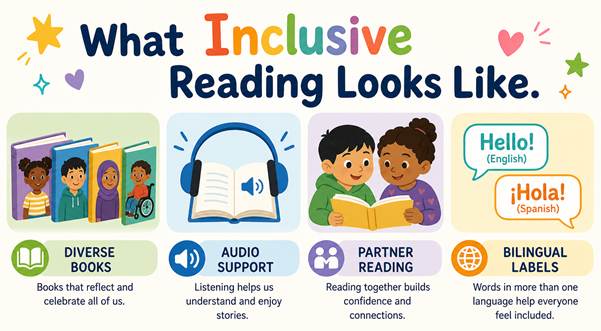
- Using audiobooks for students who struggle with reading
- Including stories from different cultures
- Supporting students with learning differences (like dyslexia)
- Letting students choose what they read
It is also about creating a classroom that feels calm, safe, and welcoming to everyone.
Tip 1: Fill the room with many kinds of books
If every book looks and sounds the same, many kids will just tune out. Put out stories with different characters, cultures, and reading levels. Mix fiction with nonfiction. Add comics, magazines, poems, and simple reference books.
This also helps kids who are not ready for long blocks of text. A student can still read a short poem or a picture book and feel successful. That success builds confidence, and confidence keeps them going.
Source: Pexels
Tip 2: Make reading choices visible
Kids read more when they have some say in what they read. Offer a few choices instead of one required path. Let students choose between two books, or between reading silently, reading with a partner, or listening to a text first.
Choice helps because kids come with different strengths. One child may love stories. Another may connect more with facts, sports, animals, or science.
A good reading space leaves room for everyone. You can even create literacy-friendly spaces with materials in different forms and levels, which leaves even more room for different choices.
Tip 3: Use read-alouds and talk time
Not every student needs to read every word alone to learn from a text. Reading the text aloud can be a great solution. Partner talk helps them process ideas. Small-group talk gives shy readers a way in.
This is also a great way to include everyone. A child who struggles with decoding may still understand the story. A child learning English may catch meaning through hearing, seeing, and talking. A stronger reader may hear a new thought and learn how to explain it.
Tip 4: Make room for culture and language
Books feel more personal when readers can see their own lives in them. That includes names, neighborhoods, family types, traditions, and home languages. It also includes honoring students who speak more than one language.
You do not need to turn the whole room into a lesson about culture. But small moves matter.
Put labels in more than one language. Add books by authors from different backgrounds. Invite students to share a story from home. These choices tell kids that their world counts here.
Tip 5: Remove small barriers before they grow big
Another thing you should give some thought to is the teaching room. Flexible seating, clear labels, quiet corners, and good shelf organization all help kids focus.
So do predictable routines. When students know where things are and what comes next, they can focus more on the book and less on what’s around them. That is a plain but powerful part of inclusion.
Tip 6: Mistakes are great opportunities
Another thing that often gets missed is how we respond to struggle. In an inclusive reading space, mistakes are treated as part of learning.
Also, your feedback should be simple and specific. Instead of saying good job, you can point out what worked: “You used the picture to help you understand,” or “You went back and fixed that sentence.” Small comments like that build real skills.
Some days, progress looks like finishing a page. Other days, it looks like asking a question about the text. When students feel safe enough to try, fail, and try again, they build stamina. Over time, that steady effort turns into confidence, and confidence is what keeps them going.
Creating a space where everyone can grow
An inclusive reading environment does not need to be fancy. It just needs to be thoughtful. It needs books that welcome more than one kind of reader, routines that lower stress, and a room that makes students feel like they belong.
That is what turns reading from a task into a real habit and helps your student learn lifelong skills. And that is what helps diverse learners keep coming back.
Remember to give your students different choices and time to talk about what they read. They connect to the books more when they can see themselves in the stories. And they need a safe space to make mistakes and learn at their own pace.
You’ve got this. Happy teaching.
