
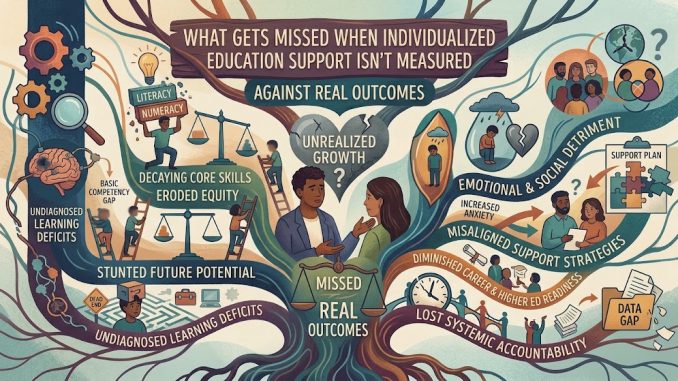
An individualized education plan often gets treated as finished the moment it’s written and signed. It becomes a document that satisfies a legal requirement.
But signing a plan is not the same as confirming it works. Without measuring a plan against real, ongoing outcome data, schools have no reliable way of knowing if it’s actually helping the student.
That gap quietly undermines the entire purpose of individualization. In this article, we cover what gets missed when plans aren’t measured against outcomes, what data-driven instruction actually looks like in practice, why this requires leadership commitment rather than individual teacher effort, and what families should expect from a plan that’s genuinely being tracked.
What Gets Missed When a Plan Isn’t Measured Against Real Outcomes
A plan without ongoing outcome measurement can stay unchanged for months or even years. This can happen even when it isn’t producing meaningful progress, simply because no one is checking.
This creates a false sense of security. The plan exists, meetings are held, and paperwork gets filed.
None of that confirms whether the student is actually improving in the areas the plan targets. Progress on paper and progress in practice are not the same thing.
The students most affected by this gap are often the ones whose needs are subtle. Their challenges may be slow to show visible change.
Without data, gradual stagnation is easy to miss. A student can quietly plateau for an entire school year before anyone notices the pattern.
Understanding what an individualized education plan actually involves makes this risk easier to spot. Families and educators who know what a plan is supposed to accomplish are better positioned to notice when it stalls.
What Data-Driven Instruction Actually Looks Like When Applied to Individualized Support
Data-driven instruction means collecting specific, regular evidence of a student’s progress against defined goals. That evidence is then used to actively adjust the plan rather than leaving it static.
This requires more than periodic testing. It means building routine checkpoints tied directly to the goals in a student’s plan.
Adjustments happen based on evidence as it comes in. Schools don’t have to wait for an annual review to notice something isn’t working.
When this practice is applied well, an individualized plan becomes a living document. It evolves as new evidence arrives, rather than sitting as a static record of good intentions.
This shift matters because student needs change over time. A goal that made sense in September may need adjusting by January, and only ongoing data can reveal that.
Learning why data-driven instruction matters for school leaders helps explain why this practice sits at the center of effective individualized support. It’s a leadership priority, not just a classroom habit.
Why This Requires Leadership Commitment, Not Just Individual Teacher Effort
Expecting individual teachers to independently build and maintain this level of data tracking is unrealistic. They already carry a full set of responsibilities without systemic support behind them.
Real leadership commitment looks like specific, visible choices. It means building time into schedules for data review and providing training on how to interpret progress data.
It also means creating a culture where adjusting a plan based on evidence is expected. This should be the norm, not something exceptional or rare.
Schools where this becomes standard practice tend to catch stalled progress far earlier. Schools that leave data review to individual initiative often miss those same warning signs.
This systemic support is what separates schools where plans meaningfully evolve. In schools without that support, plans often get revisited only once a year by default.
What Families Should Expect From a Plan That’s Genuinely Being Tracked
Families should ask specifically what data is being collected to measure progress on each goal. It’s not enough to confirm that a plan simply exists.
A well-tracked plan should show concrete evidence of what’s working and what isn’t. It shouldn’t rely on general impressions offered casually at a review meeting.
Families who ask these questions help reinforce an important expectation. A plan’s value should be measured by outcomes, not by its existence on paper.
Conclusion
An individualized plan that isn’t measured against real outcomes risks becoming a formality. It exists on paper without functioning as real support.
Schools that commit to data-driven review at the leadership level are the ones most likely to catch problems early. That commitment is what makes individualized support actually work as intended.
