
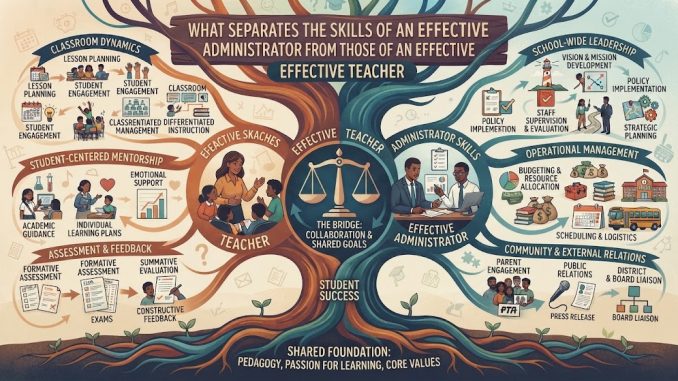
Schools are often evaluated by their outcomes for students. Those outcomes are shaped by two distinct groups of adults, administrators and teachers, whose effectiveness depends on very different skill sets.
What separates the skills of an effective administrator from those of an effective teacher matters directly to the developmental environment a child experiences at school. Each role shapes that environment in a different way.
In this article, we cover what skills define an effective school administrator, what skills define an effective teacher, how these two skill sets interact to shape a child’s school environment, and what this means for understanding school quality from a child-development perspective.
What Skills Define an Effective School Administrator
Effective administrators need skills in organizational leadership, resource allocation, and building a coherent culture across an entire school or system, rather than working directly with individual students day to day. These are systems-level skills, focused on how an entire institution functions rather than on any single classroom interaction.
Building consensus among staff, managing budgets, and setting a coherent school-wide vision require a fundamentally different kind of competence than classroom instruction.
The Wallace Foundation’s research on the impact of school leadership on student outcomes has found leadership to be a significant, measurable factor in overall school performance. That research has repeatedly identified leadership as one of the strongest school-level influences on student outcomes, second only to classroom teaching itself.
These skills shape the conditions teachers work within, including staffing, support resources, and school-wide expectations that affect classroom quality indirectly. A well-run school gives teachers the tools, time, and support they need to do their own work effectively, from adequate materials to reasonable class sizes.
This indirect influence means administrative effectiveness matters for child development even though administrators rarely interact with students one-on-one. The Interstate School Leaders Licensure Consortium standards for school leadership reflect this reality, framing leadership competency around exactly this kind of system-wide influence on student outcomes.
What Skills Define an Effective Teacher
Effective teachers need skills in direct instruction, relationship-building with students, and adapting their approach to individual developmental needs in real time. These skills operate at a much more immediate, personal level than the systems-focused work of administration.
Understanding how teachers are prepared to enter the classroom makes clear how much preparation goes into building this combination of subject knowledge and relational skill. This work happens through direct, sustained daily contact with children, giving teachers a more immediate influence on a child’s developmental experience than administrators typically have.
A teacher notices, moment to moment, when a child is struggling, disengaged, or ready for a greater challenge. Becoming skilled in this role requires developing both subject-matter competence and the relational skill to apply it effectively with children.
The Council for the Accreditation of Educator Preparation’s standards for teacher preparation reflect this dual requirement, emphasizing both academic content knowledge and skill in classroom practice as essential components of readiness.
How These Two Skill Sets Interact to Shape a Child’s School Environment
A skilled teacher working within a poorly led school can still be constrained by inadequate resources or unclear expectations set at the administrative level. Even an excellent teacher cannot fully compensate for a school-wide shortage of materials, support staff, or coherent direction.
A well-led school without skilled teachers in the classroom will still fail to translate good administrative decisions into a strong developmental experience for children. Strong systems and policies mean little if the daily classroom experience does not reflect them.
A child’s actual experience of school depends on the combined effect of both roles being executed well, not either in isolation. Neither skill set can substitute fully for the other, since each addresses a different layer of the school environment.
What This Means for Understanding School Quality From a Child-Development Perspective
Evaluating a school’s quality should consider both administrative effectiveness and teaching effectiveness as distinct, equally necessary factors. Judging a school by only one dimension risks missing a significant part of what actually shapes a child’s experience.
Families and educators assessing a school environment can benefit from looking for evidence of both strong leadership and strong classroom practice, rather than focusing on one alone. Signs of strong leadership might include clear communication and adequate resources, while signs of strong teaching show up in how engaged and supported individual students appear.
Recognizing these as separate but interdependent skill sets offers a more accurate picture of what actually shapes a child’s developmental environment at school. That accuracy matters when families are choosing a school or when educators are working to improve one.
Conclusion
What separates the skills of an effective administrator from those of an effective teacher is not a matter of one being more important than the other. Each shapes a child’s school environment in a distinct way.
Understanding both roles clearly gives families and educators a more accurate way to evaluate what actually supports healthy development within a school. A complete picture of school quality requires looking at both, not settling for a partial view.
