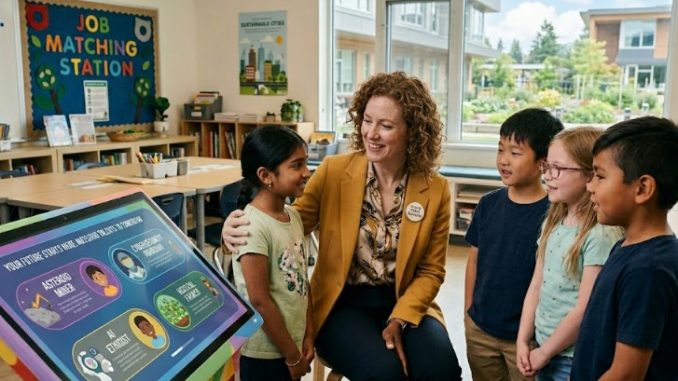
Everyone tells you to be a doctor, lawyer, or accountant. But there are hundreds of careers out there that most kids never hear about until it’s too late to fall in love with them.
By Ed Shapiro | SensoryEdge | For educators, parents, and the curious kids in your life
Picture a classroom of 30 eight-year-olds. Ask them what they want to be when they grow up. You’ll hear the same eight answers over and over: doctor, lawyer, teacher, vet, firefighter, soccer player, YouTuber, maybe astronaut.
Not because those are the only good options. Because those are the only ones they’ve ever heard of.
Here’s the truth: the modern world runs on thousands of different kinds of expertise. The city you live in was designed by someone. The medicine your doctor prescribes was tested by someone else entirely. The color of your favorite cereal box was chosen by a professional. The app you use to play games was built by a team of people with job titles that didn’t exist twenty years ago.
“You can’t want to be something you’ve never heard of. The problem isn’t ambition. It’s exposure.”
This post is about fixing that. Not by pushing any particular path, but by opening a door to a bigger room – one where curious kids can find something that genuinely lights them up, before they’re told what they’re supposed to want.
Many
of the jobs today’s kids will hold don’t exist yet – the pace of change makes that nearly certain
~1,000
distinct occupations listed in the U.S. Bureau of Labor Statistics
8
careers most kids name when asked what they want to be
The Built World
Every bridge, sidewalk, and skyscraper started as an idea in someone’s mind. These are the people who shape the physical world around us.
🏙️
City Planning
Urban Planner
They decide where roads go, where parks get built, and why some neighborhoods feel nice to walk around and others don’t. They think about cities like giant puzzles – how do you fit homes, schools, shops, and trees together so it all works?
Fun Fact
The High Line in New York City – an elevated park built on an old railway – was designed by urban planners who turned something abandoned into one of the most visited places in the country.
💡
Acoustics Engineering
Acoustical Engineer
They design rooms so that music sounds beautiful, speech is clear, and noise from outside stays out. Every concert hall, recording studio, and whisper room on the planet was shaped by one of these professionals.
Fun Fact
The Sydney Opera House required years of acoustic engineering – including the exact angle of the ceiling panels – so that a whispered onstage cue could be heard in row 40 without a microphone.
🌊
Hydrology
Hydrologist
They study water – where it goes underground, how rivers form, why floods happen, and how cities get clean drinking water. Without them, most modern cities would run out of water or be underwater.
Fun Fact
Hydrologists in Las Vegas helped engineer a system that recycles about 99% of the city’s indoor water – remarkable for a desert city of two million people.
Science You Can Touch
Everything is made of something. These scientists figure out what that something should be – and how to make it better.
🧪
Material Science
Materials Scientist
They invent new materials: lighter metals for spacecraft, fabrics that regulate body temperature, screens that bend without breaking. Your phone’s glass, your bike helmet’s foam, your sneaker’s sole – all engineered by a materials scientist.
Fun Fact
Kevlar – the material in bulletproof vests – was invented accidentally in 1965 by chemist Stephanie Kwolek while she was working on stronger tire cords.
🧬
Biomedical Engineering
Biomedical Engineer
Not a doctor, but just as important. They design the machines doctors use – from MRI scanners to artificial limbs to the tiny sensor that monitors your heart rate. They sit right at the border of biology and engineering.
Fun Fact
The prosthetic running blades used by Paralympic athletes were developed by a biomedical engineer who lost his own leg and wanted to run again.
🌿
Ethnobotany
Ethnobotanist
They study how different cultures around the world use plants – for food, medicine, ritual, and survival. They travel to remote places, learn from indigenous communities, and help preserve knowledge that is thousands of years old.
Fun Fact
About 25% of modern pharmaceutical drugs are based on compounds first identified by ethnobotanists studying traditional medicine.
Human Behavior
Why do people do what they do? These careers are for kids who love figuring people out.
🧠
Behavioral Economics
Behavioral Economist
They study why people make irrational decisions with money – and then use that knowledge to nudge them toward better ones. They work with governments, hospitals, and companies to design systems that help people without forcing them.
Fun Fact
A behavioral economist helped redesign UK pension enrollment so workers were automatically opted in rather than out. Retirement savings rates jumped dramatically – without changing anyone’s salary.
🎨
UX Research
UX Researcher
They watch real people use apps, websites, and devices – and figure out what’s confusing, frustrating, or broken. Then they work with designers to fix it. Every button you tap easily on your phone exists because someone spent hours observing how people tap badly.
Fun Fact
When Amazon removed a required registration step at checkout, their sales jumped by $300 million in one year. A UX researcher discovered the problem; a redesigner fixed it.
🗺️
Cultural Anthropology
Cultural Anthropologist
They live inside different communities – sometimes for years – to understand how groups of people organize their lives, pass down beliefs, and create meaning together. Their findings help businesses, governments, and hospitals communicate across cultures.
Fun Fact
Many tech companies now hire cultural anthropologists to help them understand why their products succeed in one country and fail completely in another.
The Digital Layer
The internet changed everything. These are the people making sense of the new world it created.
📊
Data Visualization
Data Storyteller
They take raw numbers – thousands or even millions of data points – and turn them into charts, maps, and animations that anyone can understand. Part designer, part statistician, part journalist. The best ones can change public opinion with a single graphic.
Fun Fact
Florence Nightingale is considered the first data storyteller. In 1858, she used a rose chart she designed to show the British government that soldiers were dying from preventable infection, not combat wounds. It changed military medicine.
🔐
Cybersecurity
Ethical Hacker
Companies pay these people to break into their own systems – legally. Their job is to find the holes before real attackers do. It’s a career that rewards creativity, persistence, and thinking like a criminal without being one.
Fun Fact
Google, Microsoft, and Apple all run “bug bounty” programs that pay independent ethical hackers real money for finding security flaws – sometimes tens of thousands of dollars for a single discovery.
🎮
Game Design
Narrative Designer
They write the stories inside video games – not just the dialogue, but the whole world’s logic: what happened before the game starts, why the characters care about what they care about, how the story changes based on what you choose to do.
Fun Fact
The game “The Last of Us” started as a narrative design document outlining the father-daughter relationship at its core – the gameplay was built around the story, not the other way around.
Creativity as a Career
Art and creativity aren’t backup plans. These careers require serious skill, and pay serious salaries.
🏛️
Exhibition Design
Museum Experience Designer
They design the entire experience of walking through a museum – where you go, what you see first, what’s at eye level, how long you stay in each room. They use psychology, architecture, lighting, and storytelling all at once.
Fun Fact
The path you walk through IKEA was designed this way on purpose. Exhibition designers call it a “forced path” – it’s the same principle used to keep visitors engaged in the world’s best museums.
🎵
Music Technology
Music Producer / Sound Designer
They don’t just record music – they build it from scratch using software, hardware, and a deep understanding of both science and emotion. The “sound” of a movie, a video game, or a brand is their work. Every sonic detail is a decision.
Fun Fact
The Intel startup sound – that five-note melody – was created by a composer who was given a brief that simply said: “It needs to sound like a brand with integrity.” He wrote over 100 versions before landing on the one the world knows.
🌍
Environmental Law
Environmental Lawyer
They fight for rivers, forests, animals, and future generations – in court. They combine deep knowledge of science with the legal system to hold polluters accountable, protect protected lands, and write the rules that govern how we use the planet.
Fun Fact
Several countries – including Ecuador and New Zealand – now grant legal personhood to rivers, meaning lawyers can sue on behalf of the river itself if it’s harmed.
How Teachers Can Open That Door
Exposure doesn’t require a field trip. It requires intention.
The problem isn’t that teachers don’t care – it’s that the curriculum rarely leaves room for this kind of exploration. But a few intentional moves can change what a classroom full of kids believes is possible.
01
Mystery Career Monday
Once a week, introduce a career through clues – let kids guess what the job is before you reveal it. The detective element makes them remember it.
02
Connect It to What They Love
A kid obsessed with Minecraft already thinks like an architect. Name it. Validate it. Let them know that instinct has a professional home.
03
Real People, Not Job Titles
Bring in a parent, neighbor, or video call who works in an unusual field. A title means nothing. Hearing someone say “I get paid to study why cities flood” lands differently.
04
The “Who Made This?” Game
Pick any everyday object and ask: who designed this, who tested the materials, who decided on the color, who figured out how to ship it? Every object reveals five careers.
05
Celebrate the Niche
When a student knows a weird specific fact about something, don’t change the subject. Say “there’s probably a career in that.” Because there almost always is.
06
Read Widely, Not Just Loudly
Story time and reading corners are opportunities. Books about real professionals, especially those from underrepresented paths, plant seeds that grow slowly and deeply.
“The best thing a teacher can do isn’t to inspire a child toward a specific career. It’s to expand their sense of what’s possible – and then get out of the way.”
The world needs all kinds of minds. It needs people who love numbers and people who love stories. People who want to work with their hands and people who want to work with languages. People who want to be in the field and people who want to be in the lab.
The saddest career story isn’t the one where someone tried something and it didn’t work. It’s the one where someone spent 40 years in a job they were fine at – when they would have been extraordinary at something they never knew existed.
The earlier we expand the list, the more extraordinary people we’ll have. Not because kids are ambitious enough to dream big – they always are. Because they finally know what to dream about.
“Every niche is someone’s calling. The job is just to help them hear it.”
At SensoryEdge our focus is to educate, inform, and inspire each person caring for children to be and do their very best. It is not always easy and sometimes we don't take action (or we take the wrong action) because of a lack of understanding the real issues.
We hope that the conversations that occur here will help in some small way better the lives of children, their families, and the professionals who work with them.
We are always looking for valuable contributions to our site so if you are interested in becoming a contributor contact us.