
You Don’t Have
to Be a Vet
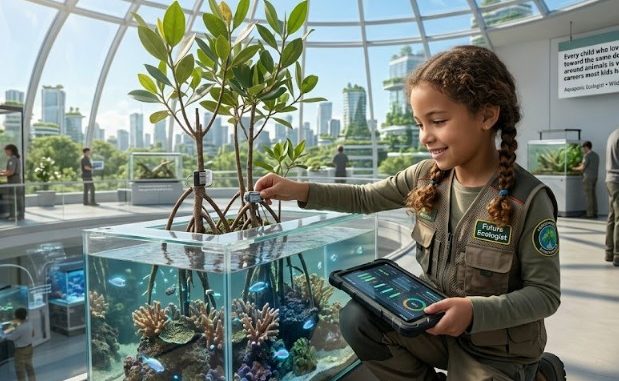
Every child who loves animals gets pointed toward the same door. But the world built around animals is vast, varied, and full of careers most kids have never been told exist.
Field Guide · Series IV
Ask a child who loves animals what they want to be and the answer is almost always the same: a veterinarian. It is a fine and honorable profession. It is also one answer out of hundreds.
The world of animal-focused careers is enormous. It stretches from field research in remote wilderness to laboratory science, from behavioral training to legal advocacy, from ocean depths to conservation policy offices. Many of these careers do not require years of veterinary school. Some of them do not require a science degree at all. All of them require a genuine, sustained interest in the natural world and the creatures that inhabit it.
The problem, again, is exposure. A child who loves horses knows about being a vet or maybe a trainer. They almost certainly do not know about equine nutritionists, animal behaviorists, wildlife corridor designers, or the scientists who study how animals communicate. The interest is there. The map is missing.
“Loving animals is not a personality trait. It is a direction. The question is where, specifically, that direction leads. There are far more destinations than most children are ever shown.”
What follows is a field guide to twelve careers built around animals that most kids never hear about. Each one is real, practiced by working professionals, and accessible to a child who starts paying attention now.
For kids who want to be outside, moving, observing.
They study wild animals in their natural habitats: tracking migration patterns, measuring population health, documenting behavior, and providing the data that governments and conservation groups use to protect species. The job often involves months in the field, living close to the animals being studied. No two seasons look the same.
Biology degree, fieldwork tolerance, patience over months or years of observation, and the willingness to work in conditions that are rarely comfortable.
The population data behind every endangered species listing, every protected habitat boundary, every reintroduction program. The science precedes all of it.
Jane Goodall’s 60-year study of chimpanzees in Tanzania, which began when she was 26 with no formal science degree, permanently changed our understanding of primate behavior and intelligence. She is a wildlife biologist.
As human development fragments habitats, animals lose the ability to move between areas, find mates, and maintain healthy populations. Wildlife corridor designers plan the land connections between protected areas, working with governments, landowners, and ecologists to keep migration routes intact. They sit at the intersection of ecology, urban planning, and policy.
Landscape ecology, GIS mapping skills, negotiation skills, and an understanding of how both animal behavior and land-use law work.
The wildlife overpasses and underpasses you see on highways in national park regions. The land easements that let mountain lions move between mountain ranges.
Banff National Park’s wildlife crossing system in Alberta, Canada, has logged over 200,000 animal crossings since its construction. It was designed by a team of wildlife corridor specialists and is now the global model for highway-habitat integration.
They study why animals do what they do: how they communicate, form social hierarchies, make decisions, learn, and adapt. Some work in the wild, some in laboratories, and some in shelters or zoos improving the lives of animals in captivity. The field is split between pure science and applied practice, and there is meaningful work in both.
Deep observational patience, a background in psychology or zoology, and the ability to design controlled experiments that can isolate why an animal is behaving a specific way.
Improved training methods, welfare standards in zoos and shelters, insights into how animals experience emotion and pain, and breakthroughs in human-animal communication.
Research by animal behaviorists established that dogs can read human pointing gestures, a skill even chimpanzees struggle with. That finding changed how we understand domestication and led to entirely new training frameworks.
For kids who are drawn to water and what lives beneath it.
They study whales, dolphins, seals, sea lions, and other marine mammals: their communication, social structures, migration, and responses to a changing ocean. Much of the work happens on research vessels, sometimes in remote ocean locations. They produce the science behind international protections and commercial fishing regulations that affect entire ecosystems.
Marine biology background, comfort with open-water fieldwork, acoustic analysis skills, and comfort with research that takes years to produce publishable findings.
The data behind whale song research, noise pollution standards for shipping lanes, entanglement regulations for commercial fishing, and population recovery plans for endangered marine species.
Roger Payne’s discovery in the 1960s that humpback whales sing complex, evolving songs sparked a global conservation movement. His recordings sold over 100,000 copies and directly influenced the international ban on commercial whaling.
This is the vet path, but far outside the clinic. Aquatic vets care for fish, invertebrates, marine mammals, and amphibians in aquariums, research stations, fish farms, and wild rescue situations. It is one of the most technically demanding veterinary specialties and one of the least crowded. The patients can weigh 40 tons or fit in a teaspoon.
Veterinary degree with aquatic specialty training, diving certification in many roles, and expertise in species whose biology and anatomy differs radically from terrestrial animals.
Health protocols for aquarium collections, rehabilitation of stranded marine mammals, disease control in commercial aquaculture, and medical care for endangered ocean species.
The Pacific salmon industry employs aquatic vets whose disease management work protects both a multi-billion-dollar food supply and wild salmon populations that share the same waterways. The two interests frequently conflict, and navigating that tension is part of the job.
For kids who love animals and love figuring out how things work.
They study the minds of animals: what they remember, what they can learn, whether they experience emotions, how they solve problems, and what that tells us about the evolution of cognition including in humans. The research ranges from testing whether crows can plan for the future to whether fish feel pain. The findings regularly overturn assumptions held for centuries.
Psychology and biology training, experimental design skills, and genuine philosophical curiosity about what consciousness is and who or what might have it.
New animal welfare standards, shifts in how we treat animals in law and agriculture, and fundamental insights into the nature of intelligence that inform neuroscience and AI research.
Alex the African Grey parrot, studied for 30 years by comparative psychologist Irene Pepperberg, demonstrated a vocabulary of over 100 words used contextually, not just mimetically. The research changed the scientific consensus on avian cognition permanently.
They study the relationship between humans and animals: how we form bonds with pets, how animals affect human health and mood, why some cultures keep certain animals and others don’t, and how those relationships have shaped both human and animal history. It is one of the newer formal disciplines, growing rapidly as the evidence base for animal-assisted therapy and companion animal science expands.
Background in psychology, sociology, or anthropology, combined with genuine animal knowledge. An unusual combination that suits people who can’t decide between studying people and studying animals.
The evidence base for therapy dogs in hospitals and schools, the research behind pet bereavement counseling, and increasingly the legal framework for how animals are classified and protected.
Anthrozoology research showing that pet ownership correlates with measurable cardiovascular health benefits has directly influenced hospital visitation policies and insurance coverage for animal-assisted therapy programs across several countries.
They use DNA analysis to answer conservation questions: how genetically diverse is a population, are two groups the same species or different, which individual animals are breeding, and what’s the best way to manage captive breeding programs to maintain healthy genetics. A single hair or dropping can yield enough DNA to answer questions that once required years of field observation.
Genetics and molecular biology training combined with an applied conservation focus. The lab and the field alternate: collecting samples in remote locations, then analyzing them with sequencing technology.
Species identification, inbreeding detection in small populations, tracking of illegal wildlife trade through DNA, and the breeding protocols behind every successful captive species recovery program.
Wildlife geneticists analyzing seized ivory and horn in illegal trafficking cases can now identify within 300 kilometers where a poached animal came from, making it possible to trace supply chains and prosecute trafficking networks rather than just individual poachers.
For kids who love animals and love arguing for what is right.
They use the legal system to protect animals: prosecuting cruelty cases, drafting animal welfare legislation, representing wildlife interests in environmental disputes, and pushing to change how the law classifies animals. The field has grown significantly as public sentiment around animal welfare has shifted and legislatures have responded with stronger protections.
Law degree with animal law specialization, offered now at dozens of law schools. Combines legal skill with genuine knowledge of animal science, welfare standards, and conservation policy.
Prosecuted cruelty cases, landmark welfare legislation, court decisions that expand legal standing for animals, and international treaty enforcement in wildlife trafficking cases.
The Animal Legal Defense Fund has won cases establishing that animal cruelty statutes apply to farmed animals, a precedent that opened an entirely new area of enforcement. Animal law is now a recognized specialty at over 170 law schools in the United States alone.
They document wildlife and wild places with the specific goal of driving conservation outcomes: changing policy, raising funds, shifting public awareness. The best practitioners spend months in the field for a single image. They are not wildlife photographers who happen to care about conservation. They are conservationists who use photography as their primary tool for change.
Technical photographic mastery, deep ecological knowledge, physical endurance, access to scientific expeditions, and an understanding of how media and public opinion actually drive policy change.
The images that appear in court cases, in legislation hearings, in fundraising campaigns, and on magazine covers that make people care about species they will never see in person.
Nick Nichols’ photographs of forest elephants in the Congo, published in National Geographic after years of remote fieldwork, directly contributed to the establishment of the Dzanga-Sangha Protected Area. A photograph changed the map.
The child who loves animals is often the easiest child to reach. The challenge is redirecting that passion from one default answer to a much wider field of possibilities.
When a student says they want to work with animals, treat it as the start of a conversation, not a career declaration. Ask: which animals, in what context, doing what specifically? The answers usually reveal a more interesting direction.
Animal careers touch mathematics (population modeling), writing (science communication), law (animal welfare legislation), economics (conservation finance), art (field illustration), and technology (tracking systems). The interest is a lens, not a lane.
Projects like eBird, iNaturalist, and the Christmas Bird Count let students contribute real data to real science from wherever they are. Participating once makes the idea of a career in field science feel tangible rather than remote.
Animal welfare, conservation trade-offs, and human-wildlife conflict are genuinely contested ethical territories. Students who love animals are often highly motivated to engage with them seriously. The debate builds critical thinking alongside the passion.
Many students who love animals are not drawn to laboratory science. Showing them that lawyers, photographers, writers, filmmakers, and policymakers are also animal careers keeps the door open for students who might otherwise feel the path is not for them.
The classroom reading corner is a place where field journals, naturalist memoirs, and science biography can sit alongside fiction. A student who reads Bernd Heinrich or George Schaller at ten is much more likely to know what a field biologist actually does at eighteen.
“The child who cries at a nature documentary is not being oversensitive. They are demonstrating the empathy and sustained attention that the best animal researchers carry their entire careers. The task is not to harden them. It is to direct them.”
It starts with a child who stops to watch something. A bird at a feeder. A spider building a web. A dog’s reaction to a stranger at the door. The noticing comes first, before any understanding of what it means or where it leads.
What that child needs, somewhere along the way, is to discover that the noticing is the beginning of a professional skill. That the patience to observe, the care to document, the drive to understand what animals are doing and why, all of these translate into meaningful work that the world genuinely needs.
The vet is a fine destination. So is the field biologist sleeping in a tent for the fourth month running, watching a wolf pack through a spotting scope at dawn. So is the lawyer who just won a case that changed how an entire industry treats the animals in its care. So is the photographer whose image of a single animal changed how a government drew its maps.
The love of animals is common. The careers it can lead to are anything but.
