
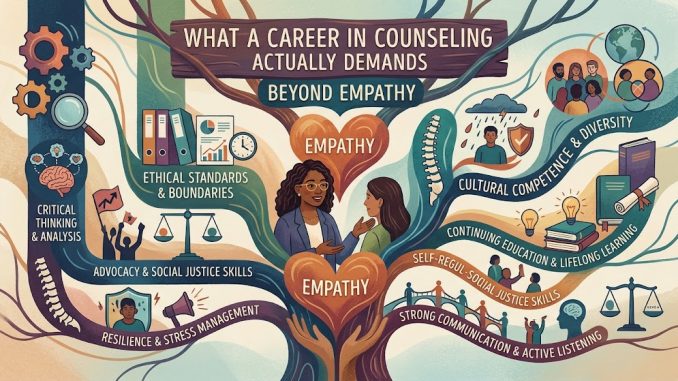
Many people are drawn to counseling because they’re naturally empathetic and good listeners. That quality feels like enough on its own, and many assume it’s the core requirement for the job.
Empathy is necessary but nowhere near sufficient. The career demands a distinct set of clinical, regulatory, and emotional-endurance skills that have little to do with simply being a caring person.
A caring presence matters in this work, but it’s the foundation, not the whole structure built on top of it. The actual job asks for far more than good instincts alone can supply.
In this article, we cover what genuine fit for the work actually requires beyond empathy, why the formal path to licensure functions as its own filter, what sustains people in the role long-term, and how someone can honestly assess whether this career is right for them.
Why Empathy Alone Doesn’t Prepare Someone for the Work
Empathy is a starting orientation, not a clinical skill. Being able to sit with someone’s pain doesn’t by itself teach a person how to structure a session, recognize risk, or apply a treatment approach that actually helps.
Counseling requires clinical judgment under uncertainty. Assessing risk, recognizing when a presenting issue requires a different level of care, and making decisions in real time all carry real consequences that empathy alone can’t guide.
Clients often present with layered, overlapping concerns. Trauma alongside substance use is a common example, and situations like this require structured clinical frameworks to address safely, well beyond simply being a supportive presence in the room.
Counselors regularly work with people who aren’t necessarily receptive to help, or whose situations don’t improve quickly. This reality requires a kind of professional resilience that caring about people, on its own, doesn’t provide.
A counselor who expects steady, visible progress from every client will struggle when change comes slowly or not at all for long stretches. Sustaining the work through that reality takes more than good intentions.
Figuring out if counseling is the right fit means honestly weighing these demands against personal strengths, not just checking whether empathy comes naturally.
Why the Formal Path to Licensure Functions as Its Own Filter
The structured path required to become a licensed clinical counselor includes extensive supervised clinical hours, competency-based coursework, and a licensing examination. All of it is designed to test far more than someone’s caring instincts.
This path exists specifically because the work carries real risk to clients if practiced without rigorous training. The credentialing process protects client welfare. It isn’t gatekeeping for its own sake, even though it can feel demanding to anyone moving through it.
Supervised practicum and internship hours, often totaling in the thousands, exist precisely to surface whether a trainee can perform this clinical judgment reliably under real conditions. Theory alone doesn’t demonstrate that a trainee can handle a genuine crisis moment with a client.
This filtering process reveals who is suited to the work in ways self-assessment alone often can’t. Supervised practice surfaces gaps that good intentions don’t, since real client interactions test skills no classroom discussion fully prepares someone for.
Someone might feel confident about their fit for counseling right up until they’re supervising their first real crisis situation. That moment often reveals far more about actual readiness than any amount of prior self-reflection.
The path to becoming a licensed counselor reflects just how much structured testing stands between good intentions and independent practice. The process is demanding by design, not by accident.
What Actually Sustains People in This Career Long-Term
Sustained clinical work carries real emotional labor. Carrying awareness of client distress across a caseload, session after session, without becoming either numb or overwhelmed takes deliberate effort over time.
Clinician burnout and compassion fatigue are well documented risks in the mental health field. Researchers like Charles Figley have studied this phenomenon extensively, and the profession has built deliberate self-care and supervision practices specifically to address it.
Counselors who stay in the field long-term are usually the ones who treat their own sustainability as a professional skill, not an afterthought. Structured supervision, peer consultation, and boundary-setting are as much a part of the job as any clinical technique.
Someone who neglects these sustaining practices often burns out faster than their clinical skill level would predict. Longevity in this field depends as much on self-management as it does on therapeutic ability.
How to Honestly Assess Whether This Career Is the Right Fit
Prospective counselors benefit from evaluating their tolerance for ambiguity and slow progress. Client change is rarely linear, and the reward of “helping” often comes slowly, if at all in any immediately visible way.
Seeking out supervised or observational experience early reveals more about fit than self-reflection alone ever can. Exposure to the actual day-to-day of clinical work shows whether someone can genuinely sustain this kind of demand.
Genuine fit for this career looks less like “I care about people” and more like something more specific. It looks like being able to sustain structured, high-stakes emotional work over years without it costing personal wellbeing along the way.
Conclusion
Empathy gets people to consider counseling, but it’s the clinical training, resilience, and sustainability practices built on top of it that actually make someone suited for the career. Caring is where the interest starts, not where the qualification ends.
Anyone genuinely considering this path benefits from testing their fit against the real demands of the work, not just their instinct to help. That honest assessment, more than good intentions alone, determines whether the career becomes a sustainable calling or an early exit.
