
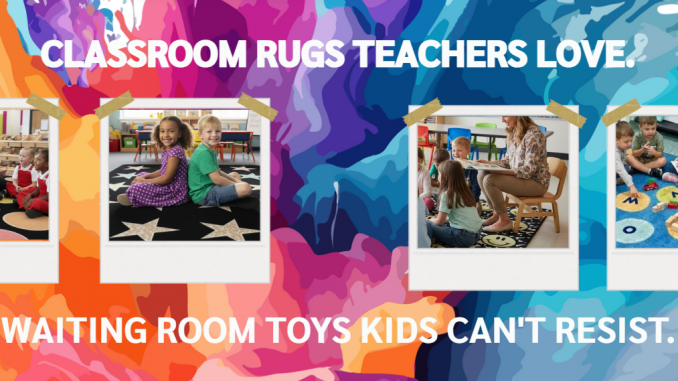
Classroom rugs for elementary schools give students a defined seating area for circle time and read-alouds, cut down on classroom noise, and double as teaching tools for letters, numbers, and shapes. At SensoryEdge, elementary classroom rugs range from $159.95 to $500+, depending on size, seating capacity, and design.
Below, we break down the types, sizing, pricing, and safety standards elementary teachers and school buyers should know before choosing a rug – plus the acoustic research behind why so many K-5 classrooms use them.
How Elementary Teachers Actually Use Classroom Rugs
A classroom rug isn’t just floor decor. In a K-5 classroom, it’s usually doing one of five jobs:
- Circle time and morning meeting – a fixed spot where the whole class gathers, which speeds up transitions because kids already know where to sit.
- Read-alouds and story time – a soft, defined space that pulls attention toward the teacher and the book.
- Assigned-seat classroom management – numbered, lettered, or shaped seating spots reduce the “where do I sit” scramble and cut down on seating disputes.
- Direct instruction – alphabet, number, and shape rugs turn the floor itself into a teaching aid for early literacy and numeracy.
- Sensory and calm-down breaks – a soft, low-stimulation rug area gives students a place to regulate between activities.
Do Classroom Rugs Reduce Noise?
Yes, and this is backed by acoustics research, not just marketing copy. The Acoustical Society of America’s ANSI/ASA S12.60 standard sets recommended background-noise and reverberation-time targets for classrooms, because excess noise measurably interferes with speech intelligibility and learning, particularly for younger students and English language learners.
Hard-surfaced classrooms (tile, vinyl, concrete) reflect sound and push reverberation times above recommended targets. Soft flooring – including an area rug installed over padding – absorbs sound energy from footsteps, moving chairs, and student chatter, which is why acoustics guidance for schools consistently lists carpet and rugs as one of the simplest, lowest-cost ways to bring a hard-surfaced room closer to recommended noise levels. A rug won’t fix a room with a serious acoustics problem on its own, but it measurably reduces impact noise and echo in a typical classroom.
Types of Classroom Rugs for Elementary Grades
| Rug Type | Best For | Typical Grade Range |
|---|---|---|
| Seating/assigned-spot rugs | Classroom management, transitions, behavior consistency | K-5 |
| Alphabet & number rugs | Early literacy and numeracy instruction | Pre-K-2 |
| Reading corner/story rugs | Library areas, independent reading, read-alouds | K-5 |
| STEAM & interactive rugs | Small-group activities, hands-on lessons | 1-5 |
| Solid & neutral focus rugs | General gathering space, low visual distraction | K-5 |
How Much Do Classroom Rugs Cost?
Elementary classroom rug pricing depends mainly on size (how many students it needs to seat) and construction (commercial-grade nylon, stain treatment, backing). At SensoryEdge, pricing for elementary classroom rugs generally falls into these tiers:
| Size / Type | Approximate Seating Capacity | Price Range |
|---|---|---|
| Small (4′ x 6′) reading-corner rugs | 4-8 students | Lower end of range |
| Medium (6′ x 9′) group rugs | 20-24 students | Mid range |
| Large (7’6″ x 12′ and up) whole-class rugs | 24-34+ students | Upper end of range |
Across these sizes, SensoryEdge’s elementary classroom rugs run $159.95 to $500+.
What Size Classroom Rug Do I Need?
As a starting rule of thumb, plan for 3-5 square feet of rug space per child, after subtracting any space taken up by furniture, and leave 18-24 inches of clearance around the rug’s edges for walking room.
| Rug Size | Approximate Capacity | Best Use |
|---|---|---|
| 4′ x 6′ | 4-8 students | Reading nook, small group |
| 6′ x 9′ | 20-24 students | Small class or reading corner |
| 7’6″ x 12′ | 24-30 students | Whole-class gathering |
| 8’4″ x 13’4″ | 28-34 students | Larger classes |
For a deeper walkthrough of sizing, shape, and layout considerations, see our full Classroom Rug Sizing Guide.
What to Look for Before You Buy
Not every rug sold as a “classroom rug” meets school procurement standards. Before purchasing, confirm the rug has:
- Class I fire rating for commercial/institutional use
- CRI Green Label Plus certification for indoor air quality
- Stain-resistant, anti-static commercial-grade construction built for daily use by young students
- Machine-washable or spot-cleanable materials, since spills are inevitable in K-5 classrooms
- Made-in-the-USA manufacturing, if that matters for your district’s procurement policy
Frequently Asked Questions
What is the average price of a classroom rug for elementary school? Pricing depends on size and brand. SensoryEdge’s elementary classroom rugs range from $159.95 to $400+ [CONFIRM exact ceiling]; across the broader market, classroom rugs commonly run from roughly $150 for small reading-corner rugs to $500+ for large, whole-class seating rugs from premium brands.
Do classroom rugs actually reduce noise? Yes. Soft flooring absorbs impact and ambient noise that hard surfaces reflect, helping classrooms move closer to the background-noise and reverberation targets set by acoustics standards like ANSI/ASA S12.60.
What size rug do I need for a class of 25 students? A 7’6″ x 12′ rug comfortably seats 24-30 students and is the most common choice for whole-class gathering areas in elementary schools.
Are classroom rugs safe for daily elementary school use? Look for a Class I fire rating, CRI Green Label Plus certification, and stain-resistant commercial-grade construction – these are the baseline safety and durability standards for school procurement.
What’s the difference between a seating rug and an alphabet rug? Seating rugs assign each student a fixed spot (numbered, lettered, or shaped) to manage transitions and behavior; alphabet and number rugs are designed as direct-instruction tools for early literacy and numeracy.
Can classroom rugs be washed? Most commercial-grade classroom rugs are spot-cleanable or machine-washable; always check the specific product’s care instructions, since materials vary by manufacturer.
