
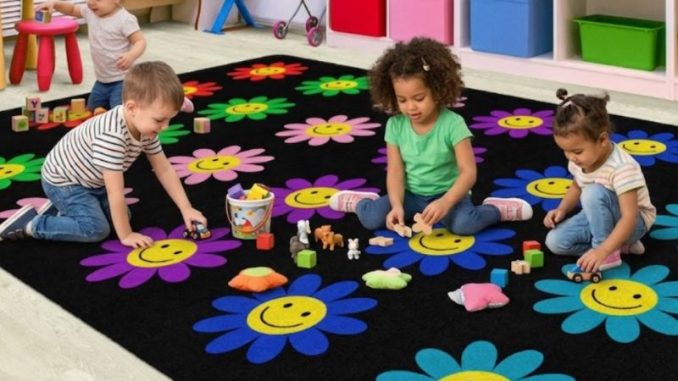
Do Classroom Rugs
Reduce Noise?
Yes. Carpet is 10 times more efficient at reducing noise than hard flooring. It absorbs sound energy rather than reflecting it, which reduces background noise, echo, and reverberation in classrooms. The benefit extends to speech intelligibility, air quality, safety, and thermal comfort. The caveat: only commercial-grade rugs built to institutional standards deliver the full benefit. Consumer-grade rugs bought to save money typically do not.
Teachers know that a classroom rug makes a difference. Most have experienced the difference firsthand: the room feels calmer, children settle more quickly into circle time, and the general noise level during instruction is simply lower. What is less widely understood is exactly why that happens, how large the effect is, and why the cheap rugs many teachers buy to stretch a limited classroom budget may not be delivering most of the benefit they are paying for.
The short answer to whether rugs reduce noise is yes, and the effect is measurable and significant. The longer answer is that noise reduction is only one of four documented benefits that a quality classroom rug provides, and that not all rugs deliver all four.
Noise Reduction:
What the Research Shows
Carpet absorbs sound energy rather than reflecting it. On a hard surface like tile, vinyl, or wood, sound waves from footsteps, chair movements, dropped objects, and voices bounce off the floor and back into the room, adding to the overall noise level and creating reverberation that makes it harder to distinguish speech from background sound. Carpet converts that sound energy into a small amount of heat through friction in the fibers, which means it never makes it back into the room as noise.
The measured difference is substantial. Carpet is 10 times more efficient at reducing noise than comparable hard flooring options. In a classroom where 25 children are moving, shifting, and talking simultaneously, that differential is not a marginal improvement. It is the difference between a room where the teacher’s voice carries clearly and one where it competes with a constant background of ambient noise that children’s developing auditory systems have to work to filter out.
Background noise in classrooms affects learning outcomes, and younger children are more vulnerable to this effect than older students. A child who is still developing phonological awareness, the ability to distinguish and process speech sounds, is working significantly harder in a noisy classroom than in a quiet one. Reducing ambient noise through floor treatment is one of the most cost-effective acoustic interventions available to a classroom teacher.
The Problem with
Cheap Classroom Rugs
Many teachers buy inexpensive consumer rugs for their classrooms because classroom budgets are tight and a cheaper rug seems like it will do the same job. It will not, and the reason matters beyond just durability. Commercial-grade classroom rugs carry specific certifications that consumer rugs do not, and those certifications exist for children’s safety, not administrative convenience.
The standards that protect your students exist. They apply to commercial rugs. They are not being enforced in every classroom, but they exist for real reasons.
Consumer rugs are not tested to NFPA 253 Class 1, the fire safety standard required for floor coverings in public buildings. A cheap area rug in a classroom does not meet this standard, regardless of what it says on the label. Commercial classroom rugs from institutional manufacturers are certified to this standard on every production run.
Consumer rugs are not independently tested for volatile organic compound emissions at the level required for school environments. Children spend extended time at floor level, where VOC concentrations are highest. CRI Green Label Plus certification confirms the rug has been independently verified to meet children’s environment air quality standards. A cheap consumer rug has not been verified to that standard.
Consumer rugs are not built for institutional foot traffic. The pile flattens, the edges fray, and the backing deteriorates under the daily demands of a full classroom. A rug that looks worn after one school year has also stopped delivering most of its acoustic and air quality benefits, since those depend on pile density and fiber integrity.
Commercial classroom rugs are treated with Scotchgard protection that causes liquids to bead rather than absorb, making spills cleanable before they set. Consumer rugs typically lack this treatment, which means spills become permanent stains quickly, and the rug becomes a hygiene concern in a setting where children are sitting directly on the floor.
A teacher who spends less on a consumer rug to save money is not getting a cheaper version of the same product. They are getting a fundamentally different product that does not meet the safety and air quality standards that commercial classroom rugs are built to. The noise reduction benefit is also diminished, since acoustic performance depends on pile density and fiber construction that consumer rugs do not match.
Four Documented Benefits of
a Quality Classroom Rug
Speech Intelligibility
Noise reduction in a classroom is not primarily about comfort. It is about how clearly children can hear and process speech during instruction. Research on classroom acoustics consistently shows that background noise and reverberation impair speech intelligibility, and that younger children, English language learners, and children with hearing difficulties are disproportionately affected. A quieter classroom is a more equitable classroom, because the students who benefit most from acoustic improvement are those who were already at a learning disadvantage in a noisy environment.
Fewer Airborne Particles
Studies on airborne dust distribution in hard-floored and carpeted spaces consistently find that walking on hard surfaces disturbs significantly more particles than walking on carpet. On hard floors, particles that have settled are kicked back into the breathing zone with every footstep. On carpeted surfaces, those particles are trapped in the pile and stay there until the rug is vacuumed. In a classroom where children spend time at floor level, this difference is meaningful.
Commercial classroom rugs from certified manufacturers also assist in allergen particle control as a specified performance characteristic, distinct from basic particle trapping. This applies specifically to rugs carrying CRI Green Label Plus certification and built to commercial fiber density standards.
Fall Impact Reduction
Carpet cushions the impact of slips and falls and meaningfully reduces the probability of injury when a child does fall. A study of slip-and-fall incidents found that of the group falling on carpet, only 17 percent sustained injury. Of the group falling on hard surface flooring, nearly 50 percent sustained injury. For a classroom of young children who are regularly moving between activities on a shared floor space, that difference compounds across an entire school year.
Commercial classroom rugs with anti-slip backing and flat, properly serged edges also eliminate the specific trip hazards that improperly secured or poorly constructed rugs introduce. A cheap rug with curling edges or inadequate backing is not a safety benefit. It is a safety risk.
Warmth and Floor Comfort
Carpet provides measurable thermal resistance compared to hard flooring, creating a genuinely warmer surface. Studies comparing carpet to other flooring materials found that carpeted spaces are perceived as warmer and more comfortable by the people using them, independent of actual temperature measurement. For young children who spend significant time on the classroom floor during circle time, read-alouds, and group activities, that comfort matters for sustained attention and engagement.
A majority of public school teachers surveyed consistently report preferring carpet for its comfort, noise reduction, and safety benefits over hard floor surfaces for early childhood instruction. The preference reflects daily classroom experience, not aesthetic preference.
A classroom rug that delivers all four benefits will be made from 100% nylon, carry CRI Green Label Plus certification for indoor air quality, hold a Class 1 fire rating under NFPA 253, have double-stitched serged edges, and be built to commercial pile density standards. Every classroom rug in the SensoryEdge catalog meets this full specification. The difference in price between a commercial-grade rug and a consumer rug is the cost of four documented benefits your students deserve.
Shop Commercial-Grade
Classroom Rugs
Every rug in the SensoryEdge catalog is 100% nylon, CRI Green Label Plus certified, Class 1 fire rated, Scotchgard protected, and made in the U.S.A. Built to deliver every benefit described in this guide.
