
Two New Alphabet Rugs
Built for Early Learners
Two distinct designs. One warm and boho, one clean and pastel. Both built to help PreK and Kindergarten children connect with the alphabet every time they sit down for circle time.
The most effective early literacy tools share one quality: children encounter them daily without feeling like they are studying. An alphabet rug is one of the most reliable ways to achieve that. Every time a child finds their seat, they are reading letters. Every circle time is a letter-recognition session, even when the lesson is about something else entirely. The alphabet is just there, surrounding them, becoming familiar through repetition that requires no extra effort from anyone in the room.
These two new SensoryEdge exclusive alphabet rugs do exactly that, and they do it in two very different visual languages. One is warm, earthy, and boho. One is clean, pastel, and classroom-forward. Both are built on commercial-grade nylon, manufactured in the USA, and designed to earn a permanent place in a PreK or Kindergarten classroom.
How Daily Exposure
Builds Letter Knowledge
Passive Recognition Builds Active Knowledge
Children who are surrounded by letters every day during circle time, story time, and transitions absorb letter forms through repetition before they can consciously explain what they know. The rug does not replace phonics instruction. It builds the visual familiarity with letter shapes that makes phonics instruction land faster and stick longer.
Every Seat is a Letter Prompt
When a child sits on or near a specific letter every day, that letter becomes personal. Teachers can use this naturally during morning meetings: “Who is sitting on a letter that starts their name?” No preparation required. The rug generates the question and the answer simultaneously.
Movement Anchors Memory
Kinesthetic learning, physically touching, pointing at, or moving to a letter, produces more durable letter memory than worksheet recognition alone. A child who hops to the letter H, traces it with a finger, or races a classmate to find the letter V has encoded that letter through body movement, which the research consistently shows outlasts visual-only exposure.

Boho Flower
Alphabet Rug
A deep espresso background with the full alphabet rendered in warm pastel boho-style lettering, each letter accompanied by small daisy flower accents. The same design language as the Boho Flower Power seating rug, extended here into an alphabet learning context.
The dark background gives each letter strong visual contrast and makes the warm pastel palette pop with clarity. The flower accents add visual interest without competing with the letters for attention. Every child in the circle is within close visual range of multiple letters at any moment during instruction.

Pastel Chalkboard
Alphabet Rug
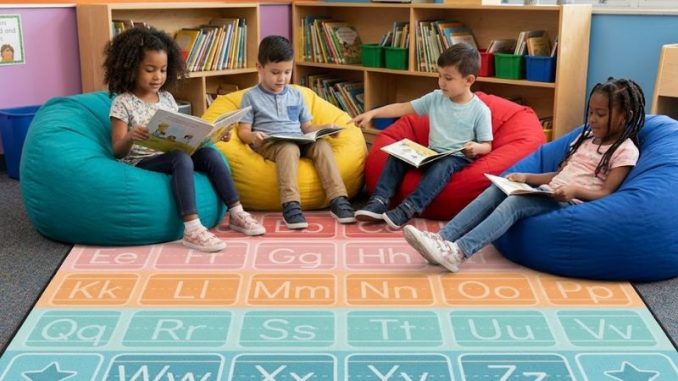
A gentle pastel ombre background, moving from warm coral through peach, yellow, green, and into cool teal, with each letter of the alphabet displayed in a clearly labeled grid square. Both uppercase and lowercase are shown for every letter, which is the single most important feature for early phonics readiness.
The clean grid structure mirrors the format children encounter in classroom alphabet charts and early reading materials, which makes the rug feel familiar and authoritative rather than decorative. This is the most curriculum-aligned alphabet rug in the SensoryEdge collection. It is built for classrooms where letter instruction is a daily priority and the room itself needs to reflect that.
A Complete
Boho Classroom Floor
The Boho Flower Alphabet Rug was designed to pair directly with the Boho Flower Power Seating Rug.
Use the seating rug for circle time and group instruction: each flower is a personal seat with a built-in organizational system. Place the alphabet rug in the reading corner or literacy center: children encounter the full alphabet in the same visual language every time they move to that area. Two rugs, one cohesive classroom aesthetic, a complete boho classroom floor that works as a teaching environment from the first day of school.
Circle time, group instruction, daily seating. Six earth-tone daisy seats on espresso background.
Reading corner, literacy center, alphabet reference. Full A-Z with floral accents on matching espresso ground.
Four Ways These Rugs
Support Literacy Development
Daily Letter Exposure
Children who encounter the alphabet in their physical environment every day absorb letter forms faster than those who encounter them only during dedicated instruction time. The rug makes the alphabet a constant, low-pressure presence in the room.
Uppercase and Lowercase Together
The Pastel Chalkboard Alphabet Rug shows both letter cases for every character, which is the format children need to see to build complete letter knowledge. Upper-only alphabet displays create recognition gaps that show up later in early reading.
Kinesthetic Letter Activities
Both rugs support movement-based alphabet activities: hop to your letter, race to find the first letter of your name, step on every vowel. Physical interaction with letters produces more durable recognition than visual-only exposure alone.
Works Before Children Can Read
The alphabet rug begins working on the first day, before formal instruction starts. A child who cannot yet name a single letter still absorbs the visual forms of letters through daily proximity. That exposure is the foundation that makes instruction faster when it begins.
Browse SensoryEdge
Exclusive Classroom Rugs
Both alphabet rugs are coming soon. Browse our full collection of SensoryEdge exclusive designs, or contact us to be notified when these become available to order.
