
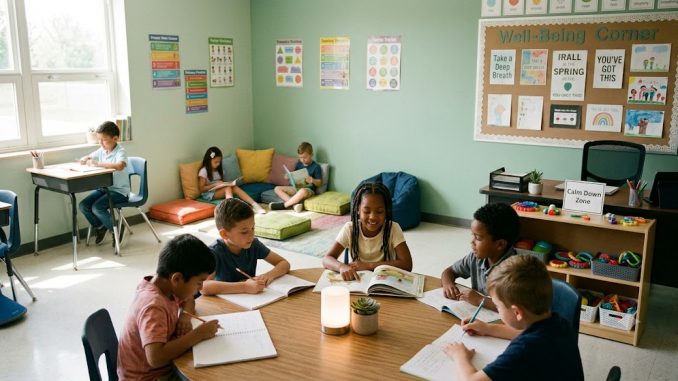
Children often show you they’re not ready to learn before the lesson has properly begun. They hover by the door, fiddle with coats, forget the first instruction or spend five minutes finding the pencil that was in their hand. These moments can look like poor behaviour when they may be signs that the room has not helped them settle into the task.
Small classroom changes can make the start of learning feel less like a jump. The aim is not to make every room look the same or remove personality, but to reduce the avoidable friction between arriving, listening, thinking and joining in.
Make Arrival Feel Predictable
The first few minutes matter because they tell pupils what kind of lesson they have entered. A clear place for bags, a visible starter task and the same entry routine each day can stop children waiting for adult attention before they begin.
Children lose less energy guessing what comes next when teaching behavioural routines is treated as part of the lesson itself, from how pupils enter the room to how equipment is collected and put away.
Keep the Room Working, Not Busy
Displays can celebrate work, share vocabulary and make a classroom feel cared for, but too much visual noise can compete with the lesson. Writing prompts, number lines and topic boards are most useful when children know where to look and why.
Within a private school, classroom choices should support the promise of attentive teaching rather than simply making rooms look impressive on open days. The debate around classroom displays is useful because decoration should earn its space by helping pupils focus, remember or feel included.
Build Movement Into the Day
Children are not designed to sit still for long stretches simply because the timetable says so. A short change of position, a task that sends them to collect a resource, or a planned stretch between activities can reduce the fidgeting that appears later as distraction.
Movement works best when it has a reason. If every transition becomes a burst of noise, the room has to be pulled back together again. Clear signals, named jobs and short time limits help pupils move without losing the thread of the lesson.
Let Children Know What Happens Next
Uncertainty can make children anxious, especially when they find change difficult. A simple visual timetable, a written sequence on the board or a reminder before switching activity can stop pupils using their energy to guess what is coming.
This is especially helpful for younger children, pupils with additional needs and anyone arriving after a difficult morning. Knowing what happens next does not remove challenge from the lesson. It gives children a safer route into that challenge.
Notice the Children the Room Doesn’t Suit
No classroom setup works for every pupil. One child may focus better away from the window, another may need instructions repeated quietly, and another may produce better work when they can stand for part of the task.
The most thoughtful classrooms are adjusted through observation rather than fashion. When teachers notice where pupils get stuck, the room can become part of the learning instead of another thing children have to battle before they begin.
