
Product Spotlight · How It Works For Children
Most circle-time rugs ask children to find a dot and sit on it. A few rugs, almost by accident, teach something while they do it. The difference is rarely the picture on the floor. It is the structure underneath the picture, and whether a teacher can put that structure to work without printing a single label.
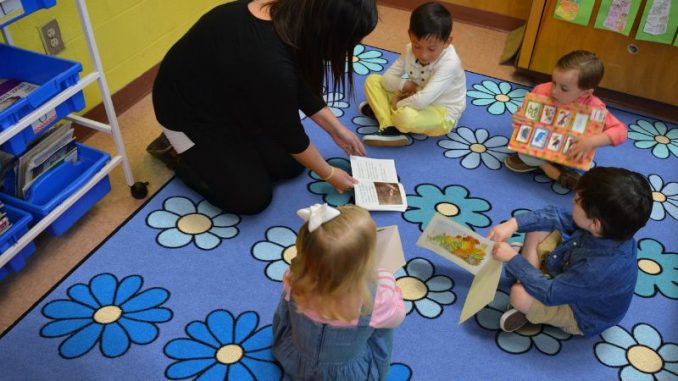
The Blue Boho Flower Seating Rug looks, at first glance, like a styling decision. Multi-columns of retro daisies, each column a different shade of blue, golden centers warming up a cool palette. It photographs well. That is the part buyers notice first. But the part that earns its keep over a full school year is quieter, and it has almost nothing to do with how the rug looks in a reading corner. It has to do with what those six columns let a teacher stop doing.
The hidden mechanic: color is the classroom management system
Walk into most early-childhood rooms and you will find a teacher running an invisible logistics operation all day. Who lines up first. Who shares their thinking next. Who pairs with whom for the cooperative task. Who rotates to the next center. Every one of those micro-decisions normally costs words, attention, and a small amount of friction, repeated dozens of times between morning meeting and dismissal.
This rug answers all of it with one structural choice: Distinct blue tones, arranged in clean columns, each one a ready-made group of children that requires no roster, no name cards, and no setup.
Aqua, Periwinkle, Teal, Ice Blue, Cobalt, and Sky
When a teacher says “teal column, line up,” a third of the room moves without anyone interpreting a seating chart. The instruction is unambiguous because the child is sitting on the answer. There is nothing to remember, nothing to misread, and no waiting while the slowest reader decodes their name tag. For a four-year-old who cannot yet read but absolutely can tell teal from cobalt, the floor itself becomes the literacy-independent system that lets them participate as fully as the child reading at grade level.
A child who cannot read their own name can still find their column. That is the whole point.
Why blue, specifically, is doing real work
It would be easy to treat the all-blue palette as a taste preference, the kind of muted, boho look that appeals to the teacher furnishing a calm reading nook. It is that. But the monochrome choice also removes a variable that multi-color primary rugs introduce without anyone noticing: visual noise competing for a young nervous system’s attention.
A floor saturated with red, yellow, green, and orange is stimuli before a single child sits down. A floor that holds the whole room inside one cool color family asks less of a child who is already working hard to regulate in a busy room. The golden flower centers keep it from tipping into cold or clinical, which matters more than it sounds, because a space that feels institutional gets resisted by exactly the children who most need the calm. The rug threads that needle: settled enough to lower the temperature of the room, warm enough that children want to be on it.
For sensory-sensitive learners, for the child who melts down at transitions, for the afternoon stretch when the whole class is fraying, a floor that is not shouting is not a small thing.
From management tool to teaching surface
The same columns that organize the room also happen to teach a concept most color curricula skip entirely: that “blue” is not one thing. Standard color activities give children eight crayons and call it a day. This rug puts aqua, periwinkle, teal, ice blue, cobalt, and sky in front of them at once and makes the differences navigable, walkable, and personal. A child’s flower is not just blue. It is periwinkle, and the one next to it is cobalt, and now the child has a word for a distinction they could always see but never name.
Ordering and gradient thinking
Ask the class to arrange themselves, or just their eyes, from the lightest column to the darkest. That is a sequencing task, an early-math skill, and a vocabulary lesson stacked into one question that takes thirty seconds and no worksheet. Lightest to darkest is the same cognitive move as shortest to tallest or fewest to most, practiced on a surface children are already sitting on.
Naming what you can see
Words like teal, cobalt, and periwinkle rarely show up in a standard color unit, yet they run through art, science, weather, and design for the rest of a child’s life. The rug makes those abstract names concrete. A child who has sat on the cobalt column all year owns that word in a way no flashcard delivers.
The blue-curriculum bridge
Because the entire palette is water-colored, the rug becomes a natural gathering point for any unit about the ocean, the water cycle, weather, or habitats. Which shade is the shallow water near the shore? Which is the deep sea? Which is the sky reflected on the surface? The floor stops being furniture and becomes the reference object for the lesson, which is exactly the kind of low-effort, high-recall anchoring that helps concepts stick in young learners.
What this means for the buyer
If you are choosing a seating rug, the temptation is to choose the most appealing image. That instinct is not wrong, but it under-weights the thing that determines whether a rug earns its place after the first week: how much work it quietly does for the adult standing in the room. A busy primary rug looks fun and then becomes background. A rug with a clean structural system gives a teacher a tool they reach for every hour, often without consciously deciding to.
The Multi-column blue design is that kind of tool. It groups children without rosters, transitions a room without raised voices, includes pre-readers without singling them out, and teaches color cognition and sequencing as a side effect of simply sitting down. The boho daisy styling is what gets it into the cart. The column system is why it is still useful in March.
The best classroom tools disappear into the routine. You stop noticing you are using them, which is the surest sign they are working.
That is the lens this series is built around. Not what a product is, but what it lets a child do, and what it lets a teacher stop doing. The Blue Boho Flower rug is a clean first case because its most valuable feature is the one you would walk right past if you were only looking at the picture.
See the rug
Shades of blue, built-in groups, one calm floor that does more than it shows.View the Blue Boho Flower Seating Rug
SensoryEdge Product Spotlight Series · How It Works For Children. Designed exclusively by SensoryEdge.
