
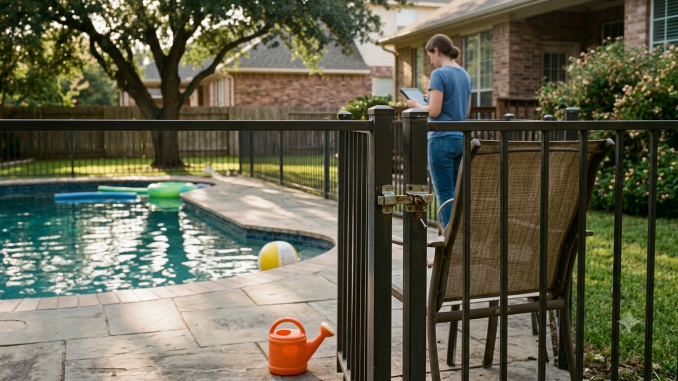
As a loving parent with a residential swimming pool, you’ve likely given extensive thought to keeping your kids safe around the pool. Most parents think about pool safety in big terms. Fences go up. Rules are repeated out loud. Someone is always supposed to be watching. That feels responsible, and it is. But the gaps usually appear in smaller moments, not dramatic ones. A chair gets moved. A latch sticks. A routine shifts. These are things that parents often overlook.
Why Being Able to See the Pool Matters
Common pool-surround decorative items like exotic plants, storage containers, and umbrellas disrupt important sightlines. Clear sightlines let you monitor the pool and surround in an instant. You should be able to glance up and know who’s in the water, who’s climbing out, and who’s sitting on the edge.
Keep these extra items along the fence line, where they don’t encumber sightlines but remain accessible.
When Gates Are Treated Like Furniture
Gates are easy to overlook once installed. They become part of the background. The problem is that many gates rely on people remembering to close and latch them correctly. That is not realistic, especially during busy days or social gatherings.
A self-closing, self-latching gate takes memory out of the equation. It works even when someone is distracted or in a hurry. Latch height matters more than many parents realize. If a child can reach it, the gate is no longer a barrier. Gates also need attention over time. Hinges loosen. Latches stick. Small failures add up quietly.
Where Falls Actually Happen
Not every pool injury involves water. Many happen just outside it. Stubbing a toe is nothing when compared to a fall. The combination of wet feet and a smooth surround creates dangerous conditions for slips to occur. Decorative stone, sealed concrete, and glossy tile may look amazing, but they aren’t practical for families with pools and children.
There are so many pool-surround finishes to choose from that are nonslip, it doesn’t make sense to consider anything else.
Why Rules Need Reinforcement
Pool rules only work when kids see them as consistent. Saying them once does not build habits, so gentle reminders make good sense.
When rules are predictable, kids are more likely to follow them without pushing limits every time. It means that parents are serious about the rules, with no room for argument.
Emergency Plans Should Be Automatic
When emergencies happen, the amygdala inhibits the thought process, making it harder to take appropriate action. That’s why potential emergencies must be thought out ahead of time, so the actions are automatic and don’t require making hasty decisions. Planning saves precious seconds.
Have a designated spot at the pool where emergency numbers are posted. There should be a first aid kit, a life ring in good condition, dedicated clean, dry towels, and anything else useful you might think of.
Maintenance Isn’t Just About Clear Water
A pool can look fine and still be unsafe. Loose ladders, cracked edges, broken lights, and worn drains create risks that are easy to miss. Incorrectly balanced water can cause sickness. Regular checks help catch issues before they become problems.
Many families rely on professional pool services to handle equipment inspections, water balance, and repairs. That ongoing maintenance supports safety by keeping systems reliable and reducing unexpected failures that disrupt supervision.
Why One Safety Feature Is Never Enough
No single solution covers everything. Supervision fades. Rules get tested. Equipment wears down. Layered safety accepts that reality. Clear sightlines support supervision. Secure gates limit access. Safer surfaces reduce falls. Maintenance keeps everything working.
Each layer backs up the others, creating redundancies, and reducing the chance that one small oversight turns into a serious incident.
Creating a kid safe pool area is not about fear or overengineering. It is about noticing how kids actually move through the space and adjusting accordingly. When visibility, access, surfaces, routines, emergency planning, and upkeep all get attention, the pool becomes easier to manage and safer to enjoy. The result is a space where fun feels lighter, because fewer things are waiting to go wrong.
Author bio: Anthony Basilicato is the Vice President of Learning and Development at Pool Troopers, a company providing residential pool cleaning, maintenance, and repair services. With more than 20 years of experience in pool service operations, training, customer service, and construction sales, he brings extensive industry knowledge to his role. Basilicato holds a Bachelor of Science in Education from the University of South Florida and focuses on developing training programs and operational standards that support team performance and customer satisfaction.
