
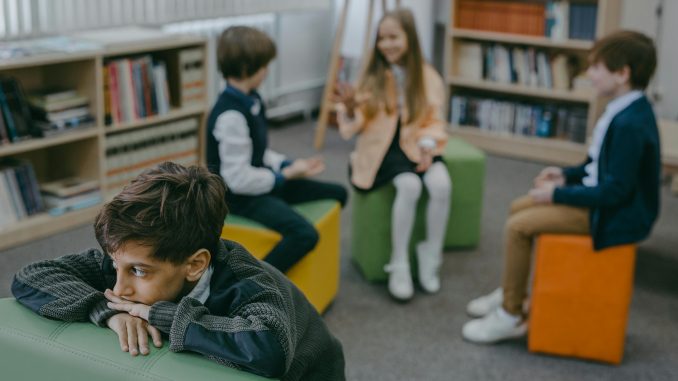
If you’re reading this as a person who grew up in an era of chalkboards and textbooks, you might not fully understand or appreciate the concept of social-emotional instruction in the classroom.
In fact, it’s a highly important and impactful concept that reflects a simple fact: a child’s environment at home influences their behavior and performance at school.
Social-emotional awareness and learning are concepts designed to help kids understand their feelings and process them productively in the school environment.
Overview
Who needs to focus on social-emotional awareness? That’s a good question, one that many parents misinterpret.
Social-emotional awareness is not only for kids who are demonstrating undesirable classroom behaviors.
It’s generally a concept taught to everyone. In many schools, kids will walk into class and be asked immediately how they’re feeling that morning.
The idea is not necessarily to flag concerning situations, though that is sometimes the outcome.
It’s to get kids thinking proactively about how their emotions can impact their learning and decision-making throughout the day.
Often, when it comes to self-regulation, basic observations are an important first step. When kids realize they’re in a mindset that often leads to poor decision-making, it can help them course-correct earlier and avoid troubling situations.
It’s also through these screening processes that kids will sometimes get identified as needing a little bit of extra attention. In those situations, there’s an entire ecosystem of professionals available to step in and provide whatever support is required.
What Kinds of Professionals Help with Emotional Social Support?
The exact answer will depend somewhat on the school’s policies as well as the resources. That said, it’s a general requirement that schools provide certain services. If they’re not able to do so with a full-time professional, they are typically responsible for arranging and facilitating appointments with third-party professionals.
All of those qualifiers notwithstanding, in the next few headings, we’ll take a look at common scenarios and the professionals who help execute them.
Social Workers
Many schools or school districts will employ at least one social worker. They are brought in to work with students who are known to be dealing with difficult home situations or troubling peer interactions.
That said, they’re not necessarily a sign that something is going terribly wrong in a child’s life. Sometimes social workers will meet with students who are just having a bad day or maybe feel a little bit anxious about school or social life.
In certain cases, social workers will push into classrooms as a way of getting to know students, teaching social-emotional skills, and also just normalizing their services to kids who might not otherwise be familiar with them.
School Psychologists
Many schools or school districts will also employ a psychologist. They’re able to intervene in situations where kids have experienced trauma at home or at school, or in cases where the child is simply displaying behaviors that seem to have a psychological root that are causing problems in the classroom.
The execution of psychological interventions will vary, but it is often similar to the way school social workers are deployed.
The psychologist may pull students for short periods of time or even do scheduled push-ins.
Speech Language Pathologists
Speech language pathologists are not exclusively operating in the domain of social-emotional awareness, but much of the work they do influences both considerations.
Barriers to speech and communication are strongly associated with higher levels of depression, stress, and anxiety in many kids. Speech impediments can significantly harm self-confidence and cause the child to become socially withdrawn.
Regular sessions with an SLP can, in this way, improve a person’s social and emotional well-being, like the other two categories of professionals that we’ve referenced up until this point.
SLPs are often employed by schools or at least school districts.
School Counselors
School counselors play an important overall role in shaping a student’s academic journey. Much of their focus is on guiding the student through the educational process by helping them select courses and possibly even choose extracurricular activities that align with their interests and potential future career goals.
That said, they’re also often the professionals who are forming personal relationships with students that can translate into social-emotional awareness.
It’s school counselors who are often the first to hear about problems with other students or difficulties at home. Virtually all high schools have school counselors on staff, and it’s an increasingly common feature of middle schools and junior highs as well.
If you’re interested in playing a pivotal role in the overall school ecosystem, a career as a school counselor is a great way to do it.
Access Is Complicated
Unfortunately, though these services are a legal right in many states, they’re harder to come by than they should be.
Because the majority of school districts are scraping by, they can’t necessarily afford a full-time professional.
Consequently, they will either use third-party services or split one psychologist/social worker/SLP across multiple schools—one, two, three, four, sometimes even five schools.
Because the resources are limited and these professionals are stretched thin, it sometimes takes a while for kids to receive the interventions that they need.
Conclusion
There is a wide variety of factors that determine how a student will do in school. Great teachers are obviously a pivotal component of the education process.
That said, it’s also important to recognize the role that social and emotional intelligence plays in the education process.
If you’re interested in the fast-paced and rewarding world of education, look into what it takes to become an SLP or start researching school guidance counselor salaries. There are so many ways to help shape the next generation of learners.
