
1st Grade
Alphabet
Lesson Plan
A complete 45-minute Language Arts lesson for first grade — from the alphabet song to independent reading, with built-in differentiation for every learner in the room.
Learning the alphabet is one of the most foundational milestones in early childhood education — and one of the most joyful. This lesson plan gives first-grade students a structured, multi-sensory 45-minute experience that moves from group singing to direct instruction, hands-on practice, and independent exploration.
Every phase builds on the last, keeping energy and engagement high while ensuring every student — from those who already know the song by heart to those still connecting letters to sounds — gets exactly what they need.
All 26 Letters, Both Cases
What Students Will Master
Identify and name all 26 letters of the alphabet — both by sight and in sequence
Recognize uppercase and lowercase versions of each letter and understand they represent the same letter
Associate each letter with its corresponding phonetic sound and begin making letter-sound connections independently
What You’ll Need
45 Minutes, Five Phases
-
1Greeting & Warm-Up
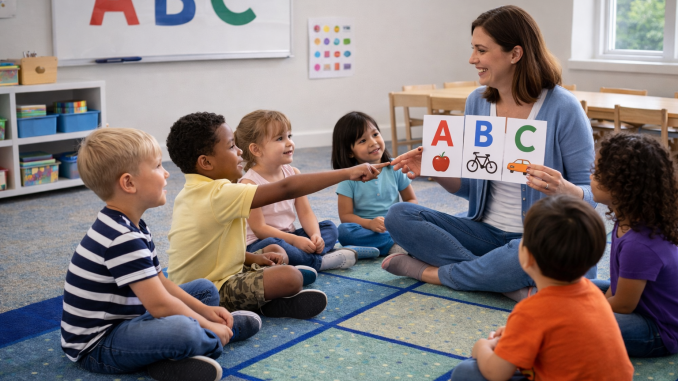
Begin with a cheerful greeting and gather students on the classroom rug in a semi-circle. Ask if they know the alphabet song — enthusiasm is contagious, and the question immediately creates investment. Ask who wants to sing it together.
-
2Alphabet Song
Play or sing the alphabet song with the whole class. Encourage students to point to each letter on the alphabet chart as they sing, tracking the sequence visually while saying it aloud. The multi-sensory combination of hearing, seeing, and pointing accelerates recognition.
-
1Alphabet Chart
Display the alphabet chart on the board. Point to each letter in order, clearly stating its name and sound. Ask students to repeat after you — both the name and the sound. Move at a measured pace, pausing longer on letters students find trickier.
-
2Flashcards — Uppercase & Lowercase
Shuffle flashcards showing uppercase and lowercase letters. Hold each one up and ask students to identify it. Emphasize that the letter has the same name and sound whether it’s big or small — just a different outfit. Mix the cases intentionally to build flexibility.
-
3Interactive Whiteboard Activity
Write several letters on the whiteboard — some uppercase, some lowercase. Invite students to come up, trace the letter with their finger or a marker, say its name, and make its sound. This kinesthetic reinforcement is especially effective for students who learn through movement.
-
1Worksheet Activity
Hand out alphabet worksheets. These can include tracing uppercase and lowercase letters, matching exercises connecting the two cases, and coloring activities that associate letters with objects. The variety keeps engagement high while reinforcing the lesson’s objectives through different modes.
-
2Teacher Circulation
Move through the classroom as students work. Check for correct pencil grip, letter formation, and understanding. Ask individual students to name a letter or make its sound as you pass — a low-pressure check-in that catches misconceptions early and gives every student a moment of personal attention.
-
1Alphabet Books
Give each student an alphabet book to explore independently. Ask them to look through the pages and find letters they recognize — pointing and saying the letter name and sound aloud as they find each one. This bridges the whole-group lesson to self-directed discovery, building the habit of independent reading engagement from the very beginning.
-
1Group Review
Gather students back together on the rug. Do a quick run through the alphabet on the chart. Ask 3–4 students to share their favorite letter and why they like it. Favorite-letter discussions reveal letter connections students have already made — and sometimes surface the most creative associations in the room.
-
2Closing Alphabet Song
End with one more round of the alphabet song — louder and more confident than the first, because that’s exactly what it will be. The bookend structure (song at start, song at end) creates a memorable frame for the lesson and gives every student a successful exit moment.
The Power of the Alphabet Song
The song isn’t just fun — it’s a mnemonic device that embeds letter sequence into long-term memory through rhythm and melody. Students who can sing it fluently have a cognitive “scaffold” they can activate anytime they need to locate a specific letter. Use it freely, early, and often.
- Observe students during all activities — note who identifies letters confidently and who hesitates
- Review completed worksheets after the lesson to assess tracing accuracy and matching comprehension
- Listen during the alphabet song — individual participation reveals comfort level more than formal tests
- Use teacher-circulation questions (“Can you tell me this letter’s sound?”) as informal real-time assessment
- Extra support: Pair struggling students with a stronger peer during worksheet time, or provide additional one-on-one attention during independent practice
- Advanced learners: Challenge them to find words that start with each letter, write simple words, or sort words by initial sound
- ELL students: Use picture-based flashcards that pair letters with familiar objects from the student’s home culture where possible
- Ask students to practice their letters at home — reading alphabet books, singing the song with family, or pointing out letters in their environment
- Send home a simple letter chart families can post on the fridge as a daily reference
- Plan future lessons to introduce phonics blends, CVC words, and more complex letter combinations using the foundation built today
- Arrange desks in a semi-circle for direct instruction — every student sees the board and the teacher sees every student
- Position the alphabet chart where it’s visible from every seat, not just from the rug
- Prepare all materials (flashcards sorted, worksheets counted, alphabet books stacked) before students arrive — transitions kill momentum in 1st grade
- Use a classroom rug for the introduction and conclusion phases — gathering on the rug signals “circle time mode” and helps with focus and transitions
Create the Perfect Learning Space
A classroom rug is where circle time happens, where students gather for morning meeting, and where lessons like this one come alive. Explore SensoryEdge’s classroom rug collection — built for exactly these moments.
